Phobias: What They Are and How They Are Treated
Written by Dr. Srishti Rastogi

Dr. Srishti Rastogi is a medical writer and healthcare professional dedicated to high-quality patient education and public health awareness. Leveraging her clinical background, she produces deeply researched, evidence-based content for digital health platforms and medical publications. Dr. Srishti’s unique dual perspective as a clinician and communicator allows her to craft content that builds trust and credibility with readers navigating sensitive health topics.
•
October 5, 2026
Our experts continually monitor the health and wellness space, and we update our articles when new information becomes available.

Quick Read
A phobia is an intense, lasting fear of a specific thing or situation, out of proportion to the actual danger, that you go out of your way to avoid. What makes it a condition is not how unusual the fear looks. It is what the avoiding costs you. Phobias are also the most treatable anxiety condition there is, and treatment is measured in hours rather than months.
You take three flights of stairs instead of using the lift. You have delayed a blood test for two years. You checked the hotel twice to make sure your room was on a low floor.
Everyone is afraid of something. But when does an ordinary fear become a phobia that needs treatment?

Allo asks
Has Fear Ever Stopped You From Doing Something Important?
What Is a Phobia?
A phobia is a strong and lasting fear of a particular object, situation or activity that is usually not dangerous [1].
The fear appears almost every time you face the thing. You may avoid it completely or get through the situation with severe anxiety.
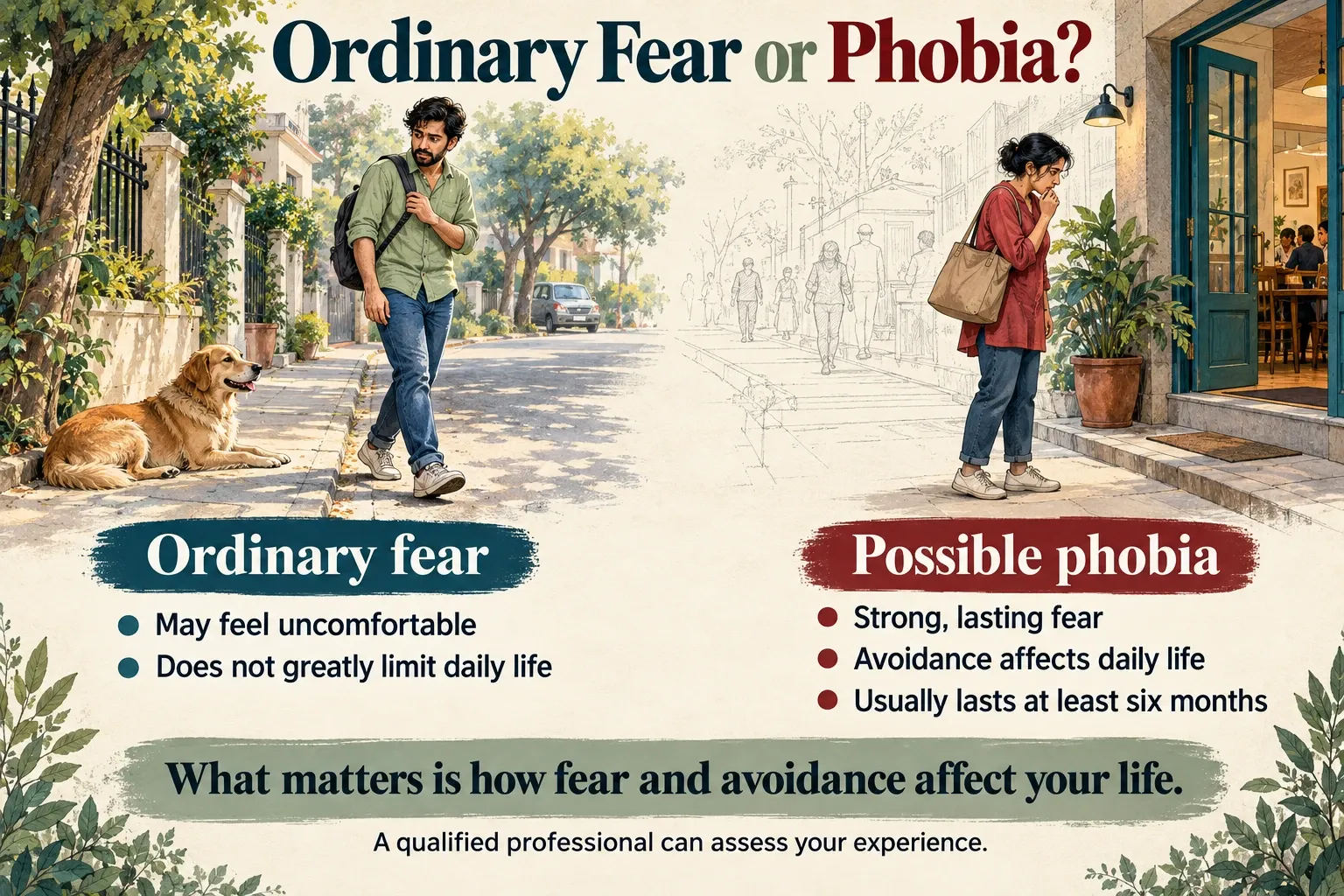
Two things separate a phobia from an ordinary dislike or fear. First, you may know that your fear is greater than the actual danger, but knowing this does not make it stop [1]. Second, the fear usually continues for at least six months and affects your daily life [3].

There are hundreds of phobia names, but knowing the name does not decide the treatment. If you want to identify a particular fear, see our list of different phobias.
Is It a Phobia or an Ordinary Fear?
The strength of the fear alone does not decide whether it is a phobia. What matters is how much you avoid and what that avoidance costs you.
Someone who fears snakes but rarely thinks about them may not have a problem that needs treatment. Someone who avoids visiting family because the journey passes a lake may be losing an important part of life because of the fear.
A phobia is usually focused on one particular thing. If your worry keeps moving between money, health, family and work, it may be closer to generalised anxiety disorder.

If your main fear is being judged, read about social anxiety disorder. If you fear places where escaping or getting help may be difficult, read about agoraphobia.
Only a qualified professional can tell you which condition best fits your experience.
What Does a Phobia Feel Like?
Facing the feared thing can cause a full fear response. Your heart may race, your breathing may become fast and you may sweat, shake or feel sick.
The fear can sometimes develop into a panic attack. Even thinking about the feared situation may trigger anxiety.
Blood, injection and injury phobias can affect the body differently. Instead of only increasing the heart rate, they may cause a sudden drop in blood pressure, which can lead to fainting [3].
This is called a vasovagal reaction. It is not a sign of weakness. During treatment, a therapist may teach you to tense certain muscles and remain seated during exposure to reduce the risk of fainting [3].
If you have fainted during a blood test or injection, tell the doctor or therapist before treatment begins.

What Are the Main Types of Phobias?
Specific phobias are grouped into five broad categories [3]:
- Animals: Dogs, snakes, spiders or insects
- Natural environments: Heights, water, storms or darkness
- Blood, injections and injuries: Needles, blood tests or medical procedures
- Situations: Lifts, aeroplanes, enclosed spaces or tunnels
- Other fears: Choking, vomiting or loud noises
The category matters because blood and injection phobias may involve fainting. However, the exact name usually matters less than people expect. Treatment works on the fear and avoidance pattern.
People often feel embarrassed because they know their fear is stronger than the actual danger. Knowing that does not make the fear unreal, and it does not mean you are weak.”
Why Do Phobias Develop?
Many phobias begin during childhood or the teenage years [3].
A phobia may develop after a frightening experience. It can also develop after seeing another person react with fear. Some people naturally have a more cautious temperament, and anxiety conditions may run in families.
Many people cannot remember when or why their fear started. That is normal.
You do not need to discover the exact cause before getting treatment. Treatment focuses on how fear affects you now.
Why Does Avoidance Make a Phobia Stronger?
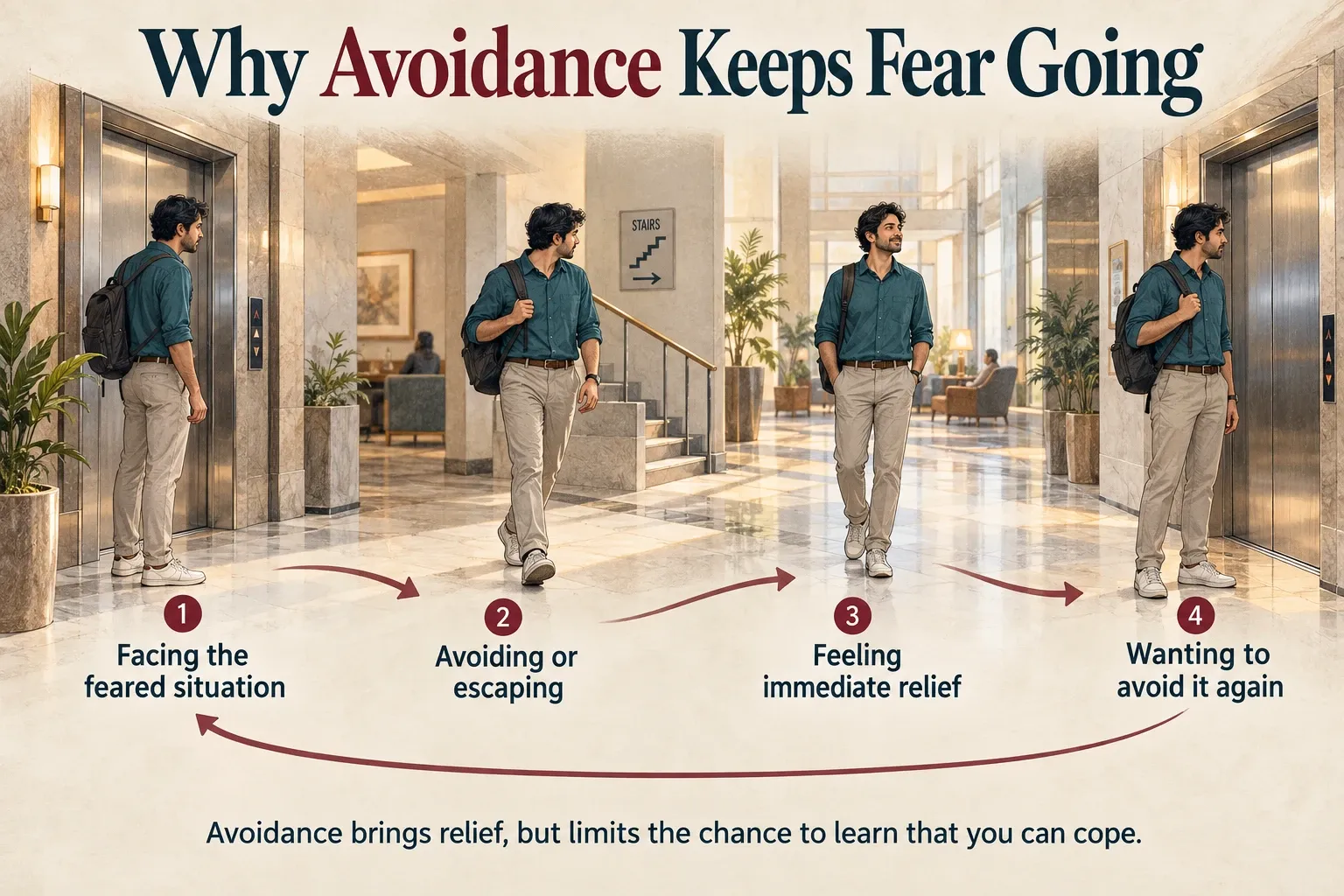
Avoiding the feared thing gives you quick relief. Your brain then learns that avoidance protects you from danger.
The next time you face the same situation, the urge to escape becomes stronger.
Avoidance also prevents you from discovering what would actually happen. For example, if you always take the stairs, you never get the chance to learn that you can ride in a lift safely.
Over time, the avoidance may spread. You may first avoid a lift, then the building containing it and eventually an important appointment inside that building. This is why a phobia can slowly make your life smaller.
How Are Phobias Treated?
Phobias usually respond well to a treatment called exposure therapy.
Exposure therapy involves facing the feared object or situation in planned, gradual steps. You stay with each step long enough to learn that you can manage the anxiety and that the feared result may not happen.
A review of 33 randomised trials found that exposure-based treatments produced large improvements compared with no treatment and performed better than placebo or other talking therapies [4].
Exposure can happen in real situations, through images or, in some cases, through virtual reality. Direct contact with the feared object or situation is commonly used, although virtual-reality exposure can also help with some phobias.
How long does phobia treatment take?
Treatment can be shorter than many people expect.
One-session treatment combines graded exposure into one appointment lasting up to three hours. Research suggests that it can help some people with specific phobias, although others may need several sessions [5].
Read what to expect in psychotherapy to understand how treatment sessions work.
Computerised CBT is not routinely recommended as the main treatment for specific phobias in adults [2]. There is also no medication approved specifically to remove a phobia [3]. A doctor may sometimes prescribe medication for another anxiety condition occurring alongside it.
Read more about psychiatric medications.

What Happens During Exposure Therapy?
Exposure begins with a step that feels uncomfortable but manageable. You are not immediately forced into the most frightening situation.
For someone afraid of lifts, treatment might begin with looking at photographs. The next step may be standing in a lobby and watching the lift doors open. Later, the person may step inside with support, travel one floor with someone and finally travel alone.
Each step is repeated before moving to a more difficult one.
Between appointments, you may practise the same steps. Slow breathing can help you remain in the situation. Read about breathing and relaxation techniques.
Exposure is best planned with professional guidance. Leaving the situation when fear is at its highest can strengthen the belief that escaping kept you safe.
When Should You Get Help for a Phobia?
Consider speaking to a professional when fear starts making decisions for you. This may include avoiding travel, work, studies, particular routes, buildings or everyday activities.
It is especially important to get help if a phobia is stopping you from receiving medical care. Delaying blood tests, dental appointments, injections or scans can affect your physical health.
A phobia may feel embarrassing, but it is a recognised and treatable condition.
If any of this sounds familiar, you can book a confidential consultation with Allo Health to understand what is happening and what treatment may help.

Disclaimer
This blog article discusses mental health and emotional wellbeing for general educational and informational purposes only. It is not a substitute for professional advice, diagnosis, or treatment, and only a qualified mental health professional, such as a psychiatrist, psychologist, or licensed therapist, can diagnose a condition or recommend treatment. If you are struggling, please reach out to a qualified professional or someone you trust; if you are in crisis or may be at risk of harming yourself, use the crisis support resources on this page. For any decisions about your mental health, we encourage you to seek the guidance of a qualified professional.
Most Asked Questions
Is trypophobia, the fear of holes, a real phobia?
It is not a recognised diagnosis in the manuals clinicians use, and it is best known as an internet topic. That does not mean the discomfort people describe is imaginary. The test is the same as for any fear: if it is intense, persistent, and you are organising your life around avoiding it, that is worth taking to a professional whatever it is called.
Does it matter what my phobia is called?
Much less than you would think. Names are useful for finding information, and one group does change the treatment plan, which is blood and injection phobia because of the fainting risk. Beyond that, exposure therapy works on the mechanism rather than the object.
Can a phobia go away on its own?
Some do, particularly mild ones from childhood. Many do not, because avoidance keeps them alive, and a phobia can sit unchanged for decades while somebody quietly plans around it. Since treatment is short and works well, waiting is usually the more expensive option.
I faint at the sight of blood. Is that a phobia?
It can be. Fainting at blood, needles, or injury is a distinct pattern where blood pressure drops rather than rises. It is common, it is not a character flaw, and treatment for it includes a technique for staying conscious, so tell the clinician about the fainting rather than only about the fear.
Will therapy make me touch a spider on the first day?
No. Exposure is graded and agreed with you before it starts, beginning far below the thing you dread most. The point is to stay long enough for the fear to fall by itself, which does not work if you have been ambushed.
Do phobia apps and virtual reality work?
Both have some evidence, and neither is the first choice. The trial evidence favours contact with the real thing over virtual or imagined versions at the end of treatment [4], and UK guidelines advise against routinely offering computerised CBT for specific phobias in adults [2]. An app is a reasonable supplement and a poor substitute.
Sources
- 1.
American Psychiatric Association. What Are Anxiety Disorders?
- 2.
National Institute for Health and Care Excellence. Social anxiety disorder: recognition, assessment and treatment (CG159), Summary of Recommendations, §9.7 Specific phobias. NICE, 2013. Hosted on NCBI Bookshelf.
- 3.
Samra CK, Abdijadid S. Specific Phobia. StatPearls. NCBI Bookshelf.
- 4.
Wolitzky-Taylor KB, Horowitz JD, Powers MB, Telch MJ. Psychological approaches in the treatment of specific phobias: a meta-analysis. Clinical Psychology Review. 2008;28(6):1021-1037. DOI 10.1016/j.cpr.2008.02.007.
- 5.
Zlomke K, Davis TE 3rd. One-session treatment of specific phobias: a detailed description and review of treatment efficacy. Behavior Therapy. 2008;39(3):207-223. DOI 10.1016/j.beth.2007.07.003.
Why Should You Trust Us?
Why Should You Trust Us?
This article was written by Dr. Srishti Rastogi, who has more than 1 years of experience in the healthcare industry.
Allo has the expertise of over 50+ doctors who have treated more than 1.5 lakh patients both online and offline across 30+ clinics.
Our mission is to provide reliable, accurate, and practical health information to help you make informed decisions.
For This Article
- We reviewed trusted clinical guidance on specific phobias, diagnosis and treatment.
- We checked published research on exposure therapy, including one-session and multi-session treatment.
- We separated specific phobias from generalised anxiety, social anxiety, agoraphobia and panic attacks to reduce confusion.
- We included the different response seen in blood, injection and injury phobias, where some people may faint.
- We explained the limits of self-help and when professional guidance is especially important.
- We used familiar examples, including lifts, flights, blood tests and medical procedures, to make the information easier to apply.