OCD: What It Really Means, and the Treatment That Helps
Written by Dr. Srishti Rastogi

Dr. Srishti Rastogi is a medical writer and healthcare professional dedicated to high-quality patient education and public health awareness. Leveraging her clinical background, she produces deeply researched, evidence-based content for digital health platforms and medical publications. Dr. Srishti’s unique dual perspective as a clinician and communicator allows her to craft content that builds trust and credibility with readers navigating sensitive health topics.
•
October 9, 2026
Our experts continually monitor the health and wellness space, and we update our articles when new information becomes available.
Quick Read
OCD is a mental health condition where unwanted thoughts (obsessions) drive repeated actions or mental rituals (compulsions) done for temporary relief. It's different from being neat or particular, OCD involves real distress, a felt need to complete the ritual, and difficulty stopping even when you want to. Common themes include contamination, checking, symmetry, harm, and religious or moral fears, and rituals don't need to be visible to count as OCD. The main treatment is exposure and response prevention (ERP), a form of CBT, sometimes combined with medication, and most people see real improvement with the right support.
Have you ever known that the door is locked or the gas is off, but still felt unable to trust yourself? You check again, feel relieved for a moment, and then the doubt returns.
For people with obsessive-compulsive disorder (OCD), this can happen repeatedly with checking, cleanliness, mistakes, safety, or even unwanted thoughts. This article explains why it happens, how OCD affects daily life and what treatment can help.
What Is OCD?
OCD is a mental health condition in which unwanted thoughts create anxiety and lead to repeated actions or mental rituals.
- Obsessions are unwanted thoughts, images or urges that keep returning.
- Compulsions are things you feel driven to do for relief, such as checking, washing, counting, praying or replaying events in your mind [1].
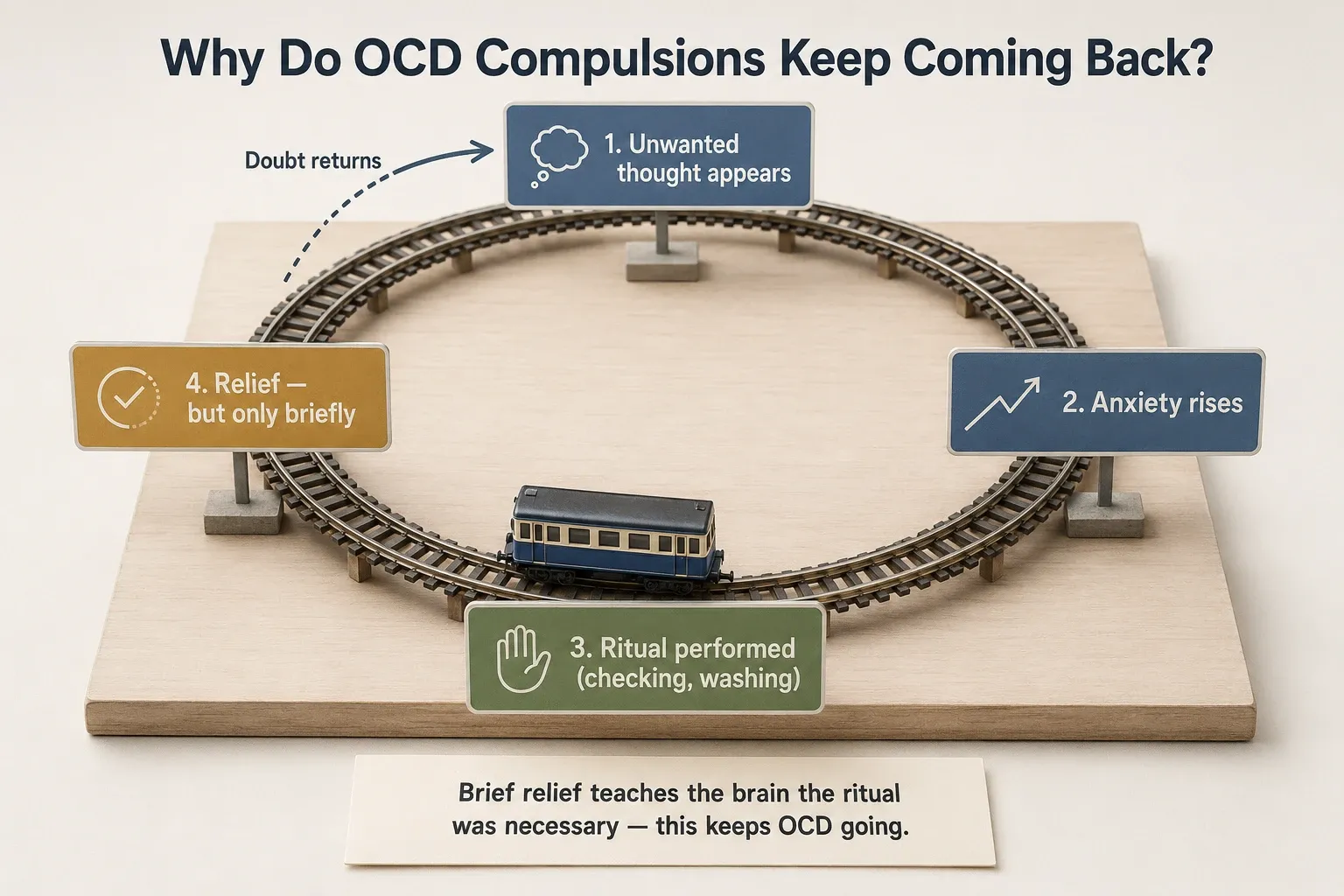
The relief is usually short. When the doubt returns, the ritual is repeated, keeping the OCD cycle going.

Allo asks
Which pattern feels closest to your experience?
What Is the Difference Between OCD and Being Neat?
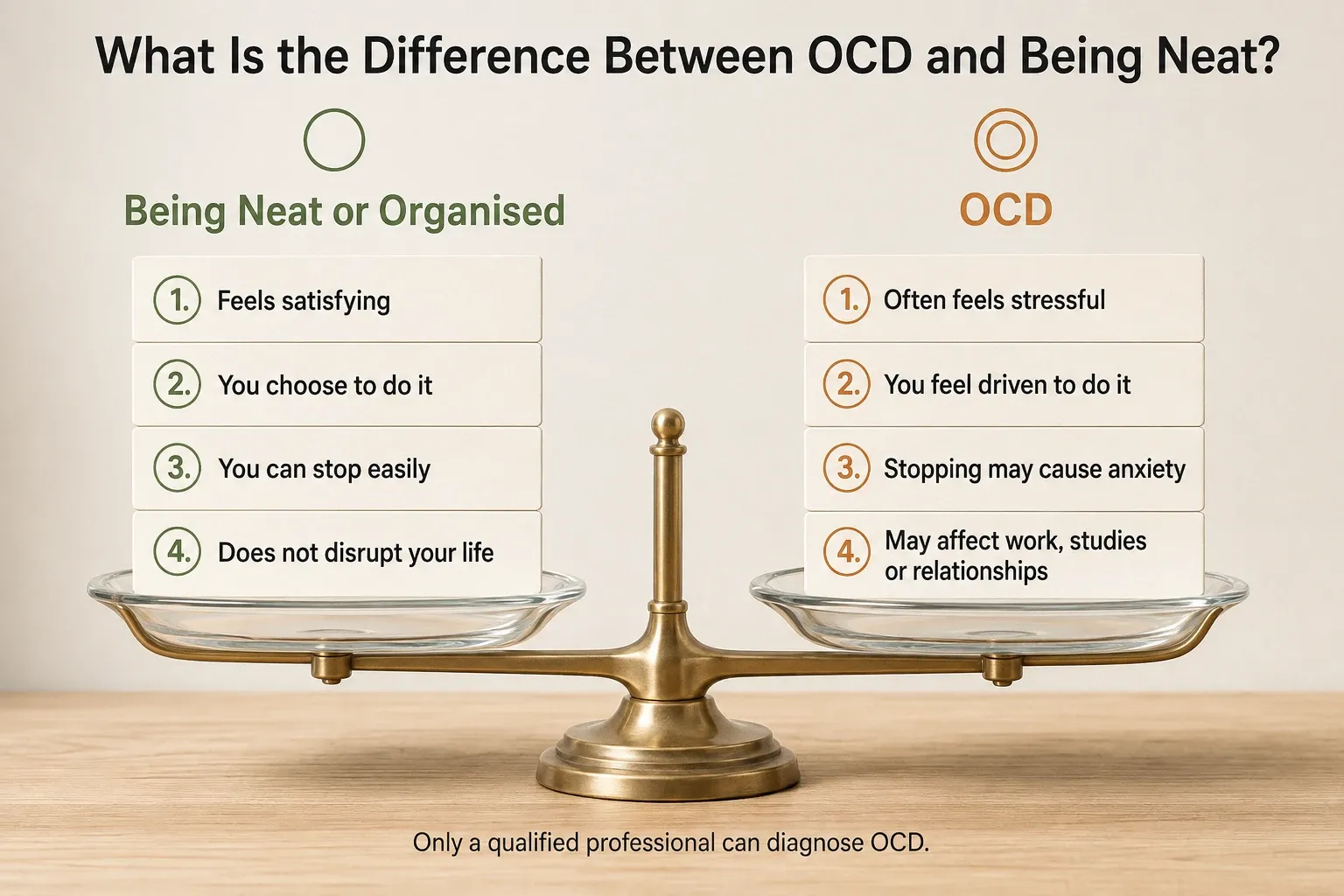
Being neat is usually a preference. OCD involves anxiety and a feeling that you must complete an action or ritual.

| Being neat or organised | OCD |
|---|---|
| Feels satisfying | Often feels stressful |
| You choose to do it | You feel driven to do it |
| You can stop easily | Stopping may cause anxiety |
| Does not disrupt your life | May affect work, studies or relationships |
OCD symptoms often take more than one hour a day or cause significant distress and disruption [1]. However, only a qualified professional can diagnose OCD.
Patients are often terrified to tell me what the thought actually was, especially violent or religious ones. I want them to hear this clearly, having the thought doesn't mean you believe it or would act on it. Almost everyone has thoughts like this. What matters is how you respond to it.
Why Do OCD Compulsions Keep Coming Back?
Compulsions keep returning because they reduce anxiety for only a short time.
The OCD cycle usually works like this:
- An unwanted thought creates anxiety.
- You perform a ritual, such as checking or washing.
- Your anxiety temporarily reduces.
- The doubt returns, so you repeat the ritual.
This brief relief teaches the brain that the compulsion was necessary, which keeps the cycle going. OCD treatment helps you experience anxiety without performing the ritual, so the urge gradually becomes weaker.

What Are the Common Types of OCD?
These are patterns clinicians see often, not a menu to place yourself in.
| Theme | What the worry sounds like | What people often do |
|---|---|---|
| Contamination | This is dirty, I will fall ill | Washing, cleaning, avoiding |
| Checking | Did I lock it, did I turn off the gas | Checking again, and again |
| Symmetry, "just right" | It still does not feel right | Arranging, redoing, counting |
| Harm | What if I hurt someone I love | Avoiding sharp objects, reassurance |
| Religious, moral | Was that thought sinful, did I pray properly | Repeating prayers, confessing |
| Relationship | Do I really love my partner | Checking feelings, reassurance |
| Sexual thoughts | What if this unwanted sexual thought means something about me? | Checking bodily reactions, reviewing thoughts, avoiding situations or seeking reassurance |
Most people have more than one theme, and themes change over the years. Compulsions are also not always visible. If your rituals happen silently in your head, that is still OCD. People with only mental compulsions are often told they cannot have it, and go years without help.
What Can OCD Be Confused With?
OCD may look similar to other conditions, but there are important differences:
| Condition | Main pattern |
|---|---|
| OCD | Unwanted thoughts lead to repeated actions or mental rituals. |
| OCPD | A long-term need for control, order and perfection. The person may see these standards as reasonable. |
| Generalised anxiety disorder | Worry affects several areas, such as health, money, family or work. |
| Health anxiety | Fear mainly focuses on having or developing a serious illness. |
Learn more about personality disorders, generalised anxiety disorder and health anxiety.
Only a qualified professional can tell these conditions apart.

Are Intrusive Thoughts Normal?
Yes. Research found that about 94% of people without OCD had experienced an unwanted intrusive thought [2]. Having a violent, sexual or religious thought does not mean you agree with it or intend to act on it. In OCD, the person may treat the thought as a warning and respond by checking, avoiding something or seeking reassurance.
In India, OCD may involve fears around prayer, morality or ritual purity. Religious practice itself is not OCD. It may be a sign of OCD when fear makes you repeat a prayer or ritual until it feels “correct,” even when you want to stop. Trying to force an intrusive thought away can make it return more often. Treatment helps you let the thought pass without responding with a ritual.
Can OCD Involve Sexual Thoughts?
OCD can involve unwanted sexual thoughts, images or doubts that feel upsetting or go against the person’s values. These may involve fears about sexual orientation, attraction or behaving in a sexually inappropriate way. A thought alone does not establish someone’s desires, identity or intentions.
The person may repeatedly check their feelings or bodily reactions, replay past experiences, or ask others for reassurance. These checks can provide brief relief but keep the doubt going.
Questioning your sexuality or exploring your identity is not itself OCD. What matters is the repeated cycle of distressing doubts and compulsions that disrupts daily life. A qualified professional can help understand the pattern.
How Is OCD Treated?
OCD is mainly treated with exposure and response prevention (ERP), medication or both.
ERP is a form of cognitive behavioural therapy designed for OCD [3]. With support from a therapist, you gradually face a trigger without performing the usual compulsion. This helps you learn that the anxiety can reduce without checking, washing or repeating a ritual.
A doctor may also prescribe medication, especially when symptoms are moderate or severe. For some people, combining ERP with medication works better than medication alone [4].
Trained ERP therapists may be difficult to find in some parts of India, so medication is sometimes offered first [5]. You can still ask whether ERP is available locally or online.
Learn more about what to expect in therapy and psychiatric medication.
When Should You Get Help for OCD?
Speak to a mental health professional if:
- Thoughts or rituals take up an hour or more each day
- You repeatedly check, wash, avoid things or seek reassurance
- The symptoms affect work, studies, sleep or relationships
- Your family has started helping you complete rituals
Many people in India hide OCD symptoms because they fear judgement or feel embarrassed. This can delay diagnosis and treatment for years [5][6]. You do not need to wait until OCD controls your entire day before asking for help.
Family members may join the checking or rituals to provide immediate relief, but this can unintentionally keep the OCD cycle going. Read more about supporting a loved one.
Can OCD Get Better?
Yes. With the right treatment, OCD symptoms can become much easier to manage. If unwanted thoughts or repeated rituals are affecting your daily life, consider speaking to a qualified mental health professional. You can book a confidential consultation with Allo Health whenever you feel ready.

Disclaimer
This blog article discusses mental health and emotional wellbeing for general educational and informational purposes only. It is not a substitute for professional advice, diagnosis, or treatment, and only a qualified mental health professional, such as a psychiatrist, psychologist, or licensed therapist, can diagnose a condition or recommend treatment. If you are struggling, please reach out to a qualified professional or someone you trust; if you are in crisis or may be at risk of harming yourself, use the crisis support resources on this page. For any decisions about your mental health, we encourage you to seek the guidance of a qualified professional.
Most Asked Questions
Can OCD be cured?
"Cured" is not the word clinicians use, but the honest picture is hopeful. With ERP, medication, or both, many people see symptoms drop enough that OCD stops running their day. Symptoms can return under stress, and knowing what to do makes those spells shorter.
Should I see a therapist or a psychiatrist?
Either is a reasonable starting point. A psychiatrist is a doctor and can prescribe, while a clinical psychologist delivers ERP. As above, guidelines treat medication and intensive therapy as comparable at moderate severity, so the assessment decides what you are offered, not which door you walk through first.
Is it OCD, or just a habit?
A habit is something you do without much thought, and you can drop it without much distress. An OCD ritual is driven by a worry you cannot dismiss, and stopping it brings real anxiety. If people around you call it a habit, that is worth pushing back on. A habit does not need treatment, and OCD responds to it.
Will I have to take medicine forever?
That is decided with your doctor, not in advance. Some people take medication for a period and stop under medical guidance; some stay on it longer, and many are treated with therapy alone. Never stop a psychiatric medicine on your own.
Sources
- 1.
American Psychiatric Association. What Is Obsessive-Compulsive Disorder?
- 2.
Radomsky AS, Alcolado GM, Abramowitz JS, et al. Part 1, You can run but you can't hide: Intrusive thoughts on six continents. Journal of Obsessive-Compulsive and Related Disorders. 2014;3(3):269-279.
- 3.
National Institute for Health and Care Excellence. Obsessive-compulsive disorder and body dysmorphic disorder: treatment (CG31), Recommendations.
- 4.
Mao L, Hu M, Luo L, et al. The effectiveness of exposure and response prevention combined with pharmacotherapy for obsessive-compulsive disorder: a systematic review and meta-analysis. Frontiers in Psychiatry. 2022;13:973838.
- 5.
Janardhan Reddy YC, Sundar AS, Narayanaswamy JC, Math SB. Clinical practice guidelines for Obsessive-Compulsive Disorder. Indian Journal of Psychiatry. 2017;59(Suppl 1):S74-S90.
- 6.
Ziegler S, Bednasch K, Baldofski S, Rummel-Kluge C. Long durations from symptom onset to diagnosis and from diagnosis to treatment in obsessive-compulsive disorder: a retrospective self-report study. PLOS ONE. 2021;16(12):e0261169.
Why Should You Trust Us?
Why Should You Trust Us?
This article was written by Dr. Srishti Rastogi, who has more than 1 years of experience in the healthcare industry.
Allo has the expertise of over 50+ doctors who have treated more than 1.5 lakh patients both online and offline across 30+ clinics.
Our mission is to provide reliable, accurate, and practical health information to help you make informed decisions.
For This Article
- We referenced the clinical distinction between obsessions and compulsions, and the roughly one-hour daily threshold clinicians use to gauge significant distress, so readers can tell the difference between everyday habits and OCD without relying on guesswork.
- We cited research showing that around 94% of people without OCD experience unwanted intrusive thoughts, so readers understand that having a disturbing thought does not itself indicate a disorder, a distinction that matters enormously for reducing unnecessary shame.
- We distinguished OCD clearly from conditions it's often confused with, including OCPD, generalised anxiety disorder, and health anxiety, so readers can recognise which pattern is closest to their own experience.
- We specifically addressed OCD themes relevant to Indian readers, including religious and moral obsessions, and were careful to note that religious practice itself is not OCD, only when fear drives repetition until something "feels correct."
- We acknowledged that mental compulsions (rituals that happen silently, without visible behaviour) are still genuine OCD, since this group is often dismissed or told they don't qualify, which can delay their access to help for years.