Peptide for Erectile Dysfunction: How It Helps Restore Sexual Function and Libido
Written by Dr. Ritu Koul
Dr. Ritu Koul is a medical professional and author specializing in sexual wellness. Through her writing, she focuses on evidence-based education, compassionate care, and breaking long-standing taboos around sexual health, intimacy, and relationships. Her work aims to empower readers with accurate information to make informed decisions about their well-being.
•
July 30, 2026
Our experts continually monitor the health and wellness space, and we update our articles when new information becomes available.

Quick Read
Peptides may help some people with erectile dysfunction, especially when standard ED pills don’t give enough improvement, but they are not a magic cure. Instead of only boosting blood flow like Viagra, peptides mainly support the brain signals, hormones, and, in some cases, blood flow that trigger sexual arousal. Early research on PT-141 and similar peptides is promising, but they can still cause side effects, and many of them are still being studied. The safest option is to talk to a doctor to find the real cause of your ED and see whether peptide therapy is the right choice for you.
Peptides for low libido (sexual desire), erectile dysfunction (ED), and other forms of sexual dysfunction are becoming a common search for people looking for options and newer approaches in sexual wellness. Most are simply trying to figure out if there’s something that can help boost desire, improve arousal, or work better for them when regular ED medications haven’t made much difference. Early research and real-life use show that some peptides may help boost sexual desire, strengthen arousal signals in the brain, and improve erection quality. But the science is still developing, and not every peptide has strong studies behind it yet. In this article, we will break down whether peptides can help with ED, how peptides may improve libido and erectile function, the types of peptides, their potential benefits and side effects, and how they compare to proven ED treatments.

Allo asks
Have you ever used peptide therapy for ED or low libido?
What are Peptides for Erectile Dysfunction?
Peptides for low libido and erectile dysfunction are a newer treatment option that many people are starting to explore. Some peptides, like PT-141, also known as bremelanotide (Vyleesi), are an FDA-approved medication used for hypoactive sexual desire disorder in premenopausal women[1], while its use in men with ED is still being studied. It’s important to know that not all peptides are FDA-approved for treating erectile dysfunction.
Peptides are small chains of amino acids that the body makes naturally — and while research continues, prescription options like Viagra (Sildenafil) for ED remain first-line. They act as messengers that help cells communicate and carry out different functions. While some support healing, energy, or hormones, a few may also play a role in sexual function. Because of this, certain peptides are now being studied for how they may support desire, arousal, and erections in people with low libido or ED.
Can Peptides Help with Erectile Dysfunction?
Some peptides may help with erectile dysfunction. Peptides act through different processes than standard ED medications, like Viagra. While Viagra (sildenafil) and Cialis (tadalafil) mainly relax blood vessels and improve blood flow to the penis, certain peptides act on the brain’s arousal centres instead.
In early studies, one group known as melanocortin receptor agonists, which work mainly in the brain, has shown that they can start an erection even without sexual stimulation, especially in men who do not respond to PDE5 inhibitors like Cialis for ED.

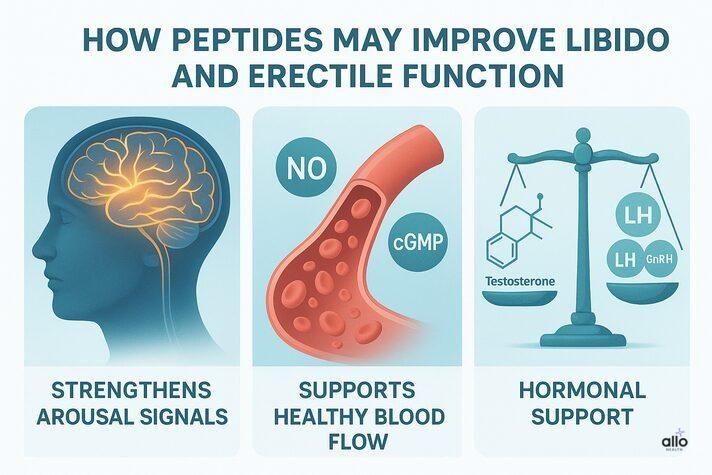
How Peptides May Improve Libido and Erectile Function
Peptides may support sexual function in several ways. Here’s a simple breakdown of how they may help:
1. Strengthens Arousal Signals
- Studies show that certain areas in the brain (melanocortin sites) play a role in sexual arousal.[2]
- When these areas are made more active by natural or synthetic peptides, they may cause or support erections. This effect comes from the brain rather than just the blood vessels.
2. Supports Healthy Blood Flow
- Some peptides may support healthy blood flow, which is essential for erections.
- Erections depend on nitric oxide (NO) and cGMP, natural chemicals that relax the blood vessels in the penis and allow them to fill with blood.
- Better blood flow makes it easier for the penis to become firm and stay firm during sexual activity.
3. Hormonal Support
- Some peptides, like kisspeptin-10, may help support the hormones involved in sexual health. These hormones include testosterone, luteinizing hormone (LH), and gonadotropin-releasing hormone (GnRH). They all work together to affect desire and arousal.[3]
- GnRH helps release LH, and LH then supports testosterone production.[4] When this process slows down, sexual desire may go down as well. This is one of the reasons some men experience low libido.
- Peptides don’t replace hormones, but they may help keep this process steady in people who have a low desire that is linked to hormonal changes.
Types of Peptides Used for Libido and ED
Here are the main peptides under study for their effects on libido and erectile function.
1. Bremelanotide (PT-141)
- Known for: Increasing sexual desire and supporting arousal.
- Form: Usually a nasal spray
- PT-141 acts on melanocortin sites (receptors) in the brain. Stimulating these receptors can affect the brain pathways that play a role in sexual arousal and desire.[2]
2. Kisspeptin-10
- Known for: supporting healthy hormonal activity.
- Form: Injection
- Kisspeptin-10 mainly controls GnRH and LH.[3] These hormones influence testosterone and sexual response. It’s not a quick arousal peptide. It balances hormones and improves overall body function.
3. Melanotan II
- Known for: supporting erections
- Form: Injection
- Melanotan II has shown the ability to cause erections in some men. In a small study of men with stress-related or psychological ED, some men noticed an erection and better firmness after receiving an MT-II injection.[2]
Disclaimer: These findings are mostly from small, early studies. Peptides are still being studied, so they shouldn’t be taken as a sure or quick cure for ED.
Benefits of Peptides for ED
Some of the common benefits are:

- Improved sexual desire and arousal.
- Better sexual response to stimulation and overall sexual performance.
- Reduced performance anxiety.
- Supports hormone balance.
- May improve blood flow.
Safety and Possible Side Effects of Peptides for ED
Peptides used for libido and erectile function may be helpful for some people, but they are not completely risk-free. To make a well-informed decision, it is important to be aware of the possible side effects and safety considerations.
- Nausea, redness or warmth (flushing), excessive sweating, and low back pain are the common side effects seen with bremelanotide.[5]
- The quality of the peptide used also plays an important role in both safety and effectiveness. Low-quality or unregulated products can increase the chance of side effects and may not work as expected.
- Many peptides sold online may not meet medical-grade standards and may be incorrectly dosed, contaminated, or mislabeled, making their effects unpredictable and potentially harmful.
- Taking more than the recommended dose or using peptides too often can make them less effective over time. The body may get used to the constant stimulation, so the same dose may stop working as well.
- This is why using peptides under medical guidance is important. Always consult a healthcare professional before starting any peptide therapy.
Peptides can be helpful for some individuals, but they aren’t right for everyone. Lifestyle, sleep, communication, and mental health can be equally powerful in improving libido and confidence.
Peptides vs. Proven ED Treatments
Here’s how peptides compare to the ED treatments and methods that have been used and trusted for years.
Feature
Peptides for ED
Proven ED treatments, like PDE5 inhibitors and hormone therapy.
How they work
Support brain arousal signals, hormones, and sometimes blood flow.
Increase blood flow or correct low testosterone only when testosterone is truly low in blood work.
Evidence level
Early research and limited human studies.
Strong clinical evidence over many years.
Helps with libido — complementary prescription options include Levitra (Vardenafil) for ED.
Yes, it may improve libido.
PDE5 inhibitors may not boost desire, while testosterone therapy can.
Helps with erections
It may help, especially in men who didn't respond to ED pills (according to a small study).
Very effective for erection firmness in most men.
Safety profile
Still being studied, quality varies when bought online.
Well-studied, clear safety guidelines.
Regulatory status
Not FDA-approved specifically for ED.
FDA-approved options are available.
Best use
As part of a combined treatment plan.
First-line treatment in most guidelines — while homeopathic approaches like Conium Maculatum for ED are sometimes explored as adjuncts.
Conclusion
Peptides may offer a supportive solution for people who struggle with low desire, erectile difficulties, or other forms of sexual dysfunction, especially when standard treatments have not helped enough. Some peptides act on the brain’s arousal pathways, while others support hormone balance. Early research shows promising results, but these treatments are still being studied, and their long-term safety is not fully known. Peptides are not the right choice for everyone. Factors such as stress, sleep, relationship dynamics, and overall health also play an important role in sexual well-being. Because the effects and risks can vary from person to person, it’s important to use these treatments under medical guidance. It’s always best to check with a sexual health expert before trying anything new. They can look for things like heart issues, diabetes, or hormone problems, common causes of ED, and help you find the safest treatment for your situation.

Disclaimer
The following blog article provides general information and insights on various topics. However, it is important to note that the information presented is not intended as professional advice in any specific field or area. The content of this blog is for general educational and informational purposes only. The content should not be interpreted as endorsement, recommendation, or guarantee of any product, service, or information mentioned. Readers are solely responsible for the decisions and actions they take based on the information provided in this blog. It is essential to exercise individual judgment, critical thinking, and personal responsibility when applying or implementing any information or suggestions discussed in the blog.
Most Asked Questions
Can peptides really increase libido?
Peptides may help improve libido for some people by influencing brain-level arousal pathways, hormones, or blood flow. Results vary widely, and they are not a guaranteed fix for everyone.
How long do libido peptides take to work?
Timing depends on the peptide. PT-141 may work within hours, while hormone-supporting peptides such as kisspeptin may take weeks of medical-supervised dosing. Always follow a doctor’s guidance.
Are peptides safe for people with high blood pressure or heart disease?
Caution is required. Some peptides, especially PT-141, can increase blood pressure temporarily. Anyone with hypertension, heart disease, or taking heart medications should consult a doctor before using peptides.
Do peptides have side effects?
Possible side effects depend on the peptide and dosage but may include nausea, flushing, headache, high blood pressure spikes, or skin changes (especially with melanotan II). Serious side effects are rare but can occur if peptides are misused or poorly sourced.
Will peptides fix ED permanently?
Peptides don’t cure erectile dysfunction. They may help with desire, arousal, or blood flow, but long-term sexual health still depends on lifestyle, hormones, mental health, and underlying medical issues.
Sources
- 1.
Novel EmergingTherapies for Erectile Dysfunction
- 2.
Melanocortin Receptors, Melanotropic Peptides, and Penile Erection
- 3.
Kisspeptin-10 Is a Potent Stimulator of LH and Increases Pulse Frequency in Men
- 4.
Update on male reproductive endocrinology
- 5.
Salvage of Sildenafil Failures With Bremelanotide: A Randomized, Double-Blind, Placebo-Controlled Study