HCG for Erectile Dysfunction: Hormonal Treatment and Effectiveness on Sexual Health
Written by Dr. Anvi Dogra

Dr. Anvi Dogra is a medical writer and healthcare professional with a doctoral background in clinical sciences. She leverages her medical training to produce deeply researched, people first content across the wellness industries. With a "360-degree" understanding of the healthcare industry, Dr. Anvi focuses on bridge-building between clinical data and patient wellness. Known for her ability to make complex medical topics accessible and engaging, Dr. Anvi ensures that all health information is grounded in clinical evidence.
•
April 22, 2026
Our experts continually monitor the health and wellness space, and we update our articles when new information becomes available.
Quick Read
If you’re wondering whether HCG can help with erectile dysfunction, the simple answer is that it may improve ED only when the problem is linked to low testosterone or hypogonadism. Some studies show good improvement in erections and libido when HCG is used under medical supervision, but the dose varies for every person and cannot be decided on your own. Because ED can also be caused by stress, health issues, or lifestyle factors, HCG is not a universal cure. The safest approach is to get a proper diagnosis and let a doctor decide whether HCG is the right treatment for you.
Human chorionic gonadotropin (HCG) is a hormone which often comes up in discussions for its effects on testosterone and male sexual health. Many men want to know whether this hormone can genuinely improve erections or testosterone levels. The short answer is that HCG can help some men with erectile dysfunction, but only when the underlying cause is low testosterone or hypogonadism. In this article, you will learn what HCG is and why it’s used in men, how HCG might affect erectile function, whether HCG can cause or worsen ED, dosage instructions, side effects, and how safe it is.
What Is HCG and Why Is It Used in Men?
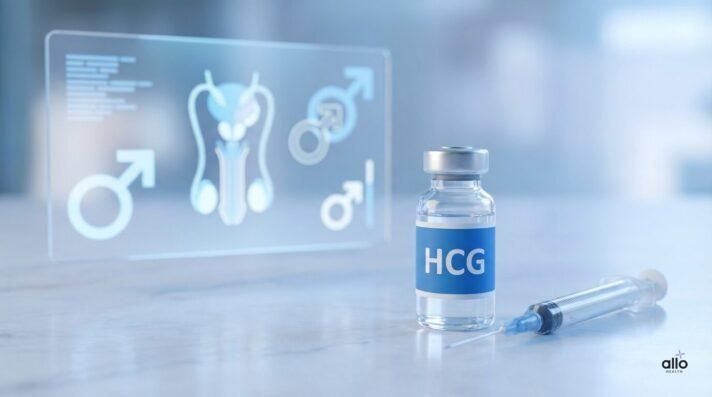
HCG (human chorionic gonadotropin) is a hormone that acts like luteinizing hormone (LH). LH signals and helps the testicles to produce testosterone and sperm. HCG is used in men to treat low levels of testosterone that is hypogonadism, improve fatigue, low sex desire and sexual dysfunction. HCG can increase testosterone, help in maintaining the size of the testes, support sperm production and can prevent testes from shrinkage. The way HCG works can be expressed in simple way as: HCG → stimulates Leydig cells in the testes → increases intratesticular testosterone → supports erections, sexual desire, and sperm production.
What is the link between HCG and Erectile Dysfunction?
When people search online about HCG and erectile dysfunction, they find a lot of mixed claims about whether HCG can treat ED or make it worse — established options like Viagra (Sildenafil) for ED have clearer evidence. The truth is that there is no strong evidence that HCG causes erectile dysfunction. HCG does not usually cause ED because it increases the production of testosterone in the body and ED becomes worse in case of low testosterone levels. HCG has also shown to preserve testicular function. These factors show how HCG may indirectly improve ED, especially when the underlying reason is low testosterone, hypogonadism, or testicular suppression due to previous testosterone therapy or anabolic steroid use. A study was done on 45 men with psychogenic erectile dysfunction who received 5000 IU of HCG twice in a week for one month. It showed that 47 percent of men improved with HCG. This study showed that HCG can also directly affect sexual function. [1] Another study evaluated HCG monotherapy in men who had normal or borderline testosterone levels. These men took about 1,500 IU weekly, and researchers found that 86% reported improvement in erectile dysfunction and 80% experienced better sex drive. There were no major side effects, showing that HCG was both effective and safe. [2] A 2019 study, done on men with low testosterone and sperm, who were not eligible for testosterone therapy took around 2,000 IU of HCG weekly for about eight months. Among these men, 45% reported erectile dysfunction as one of their symptoms, and half of the participants showed overall symptom improvement, including sexual function. [3] These studies can be considered as useful findings regarding how HCG may improve erectile dysfunction in men with low testosterone. But ED is not only caused by deficiency or lower levels of testosterone but can be caused by multiple factors. So taking a doctor’s advice and understanding the cause alongside proper diagnosis can only figure what kind of treatment should be done. ED symptoms may worsen if other causes are ignored or if someone self-doses incorrectly.
What Is The Ideal HCG Dosage For Erectile Dysfunction?
When people learn that HCG may help erectile dysfunction, the next question is, “What is the ideal hCG dose?” The truth is that there is no single ideal dose for HCG. All the dosages and amounts we see today come from different clinical trials and studies. These doses only show what worked in research settings for different people in some conditions, not what every man needs in real life. Erectile dysfunction is a multifactorial condition, and the correct HCG dose depends on a lot of factors like your hormone levels, fertility needs, age, medical history, testicular function and the underlying cause of your ED. That is why reaching out to a doctor should be your first step. HCG should never be self-dosed because the wrong amount can affect your hormones, mood, fertility, and overall health.
Side Effects of HCG
Before starting HCG, it’s important to understand safety and how the treatment may affect the body — and comparisons with Cialis for ED can help set expectations. While HCG is generally considered safe and well-tolerated when prescribed by a doctor, it can still cause some side effects especially because it directly influences hormone levels. Most side effects are mild, temporary, and manageable, but knowing them in advance helps you make an informed decision. [4] [5]

Common Side Effects
HCG is a hormone injection, which can cause some common physical side effects. Some men develop redness or pain on the site of the injection. This usually settles on its own.Some people may feel nausea, abdominal discomfort, bloating, headache, or dizziness. These symptoms are generally temporary and do not require stopping the medication unless they become continuous.
Hormonal Changes
HCG increases testosterone, but it can also increase serum estradiol (a form of estrogen) — for a direct ED treatment, options like Levitra (Vardenafil) for ED target erection pathways. This can sometimes lead to breast tenderness or very mild gynecomastia (swelling of breast tissue). The increase of estradiol can lead to mood changes in men.
Changes in Testicular Function
HCG is used to reverse testicular shrinkage, but sometimes it can create hormonal imbalance and can create a feeling of testicular heaviness and discomfort.
Allergic reactions
Some people can be allergic to ingredients in HCG injections, especially those derived from animal cells. These reactions can include rash, swelling, itching, and in extremely rare cases, anaphylaxis.

Uncommon side effects
Some side effects like risk of blood clots and thrombotic events such as deep vein thrombosis or pulmonary embolism can occur in people taking HCG — alternative homeopathic approaches like Conium Maculatum for ED are sometimes explored. Though these side effects are rare. This treatment should always be done under the supervision of a doctor so that there is a continuous check on hormone levels regularly and adjusts doses carefully. "Online information can make HCG sound simple, but hormones are complex. Getting medical treatment for ED is not just about testosterone, but to make sure you get the benefits without unnecessary risks."
The Bottom Take
HCG can be a helpful treatment for some men with erectile dysfunction, but only when ED is linked to hormonal causes such as low testosterone, hypogonadism, or testicular suppression. Erectile dysfunction is not caused by hormones alone; it can also result from stress, heart health, diabetes, performance anxiety, lifestyle habits, and relationship issues. This is why HCG is not a universal cure for ED, and it should never be taken without proper medical evaluation. If someone is facing erectile issues, the safest and most effective approach is to consult a healthcare professional.

Disclaimer
The following blog article provides general information and insights on various topics. However, it is important to note that the information presented is not intended as professional advice in any specific field or area. The content of this blog is for general educational and informational purposes only. The content should not be interpreted as endorsement, recommendation, or guarantee of any product, service, or information mentioned. Readers are solely responsible for the decisions and actions they take based on the information provided in this blog. It is essential to exercise individual judgment, critical thinking, and personal responsibility when applying or implementing any information or suggestions discussed in the blog.
Most Asked Questions
What is the recommended HCG dosage for men with low testosterone or ED?
There is no single recommended dosage because HCG needs to be tailored to each person’s hormone levels, medical history, and fertility goals. However, studies commonly use 1,500–2,500 IU per week, while clinical protocols often use 1,500–5,000 IU injected 2–3 times per week under a doctor’s supervision.
What dosage of HCG is used to improve testosterone levels?
HCG raises testosterone by acting like LH, and different studies use different amounts. Most research on testosterone improvement uses 1,000–2,500 IU twice weekly or 1,500–2,000 IU weekly, depending on the individual. Only a doctor can decide the right dosage after evaluating hormone tests.
What is the typical HCG dosage for testicular atrophy?
Testicular shrinkage due to TRT or steroid use is often managed with HCG doses between 1,500–3,000 IU taken 2–3 times weekly, but dosing varies based on testicular responsiveness. These doses help restore intratesticular testosterone and testicular size but must be prescribed by a doctor.
How long does HCG take to work in males?
Most men begin noticing improvements in energy, libido, or erectile function within 4–8 weeks, although some studies have shown changes as early as 3–4 weeks. Full hormonal stabilization may take several months of consistent, medically supervised treatment.
Is a 5,000 IU HCG dosage safe and effective?
Higher doses like 5,000 IU, used twice weekly, appear in older clinical trials and are sometimes used short-term in specific medical evaluations or severe cases. However, this is not a standard starting dose, and such high amounts should never be attempted without strict medical supervision due to the risk of hormone imbalance and side effects.
Sources
- 1.
Human chorionic gonadotropin treatment of nonorganic erectile failure and lack of sexual desire: a double-blind study
- 2.
9 Safety of Human Chorionic Gonadotropin Monotherapy for Men with Hypogonadal Symptoms and Testosterone >300 ng/dL Available for Purchase
- 3.
Human Chorionic Gonadotropin monotherapy for the treatment of hypogonadal symptoms in men with total testosterone > 300 ng/dL
- 4.
Human Chorionic Gonadotropin Injection
- 5.
Chorionic Gonadotropin for Injection, USP