Beta Sitosterol and Erectile Dysfunction: Link Between and Sexual Side Effects
Written by Dr. Anvi Dogra

Dr. Anvi Dogra is a medical writer and healthcare professional with a doctoral background in clinical sciences. She leverages her medical training to produce deeply researched, people first content across the wellness industries. With a "360-degree" understanding of the healthcare industry, Dr. Anvi focuses on bridge-building between clinical data and patient wellness. Known for her ability to make complex medical topics accessible and engaging, Dr. Anvi ensures that all health information is grounded in clinical evidence.
•
April 22, 2026
Our experts continually monitor the health and wellness space, and we update our articles when new information becomes available.
Quick Read
If you’re searching “beta-sitosterol erectile dysfunction” to know whether this supplement can help your erections, the short answer is no. Beta-sitosterol is useful for cholesterol and benign prostate hyperplasia symptoms, but human studies do not show any benefit for ED, and in a small number of men it may even cause problems like reduced libido or weaker erections. Some animal research shows sexual effects, but those results don’t apply to humans, and beta-sitosterol is not a testosterone booster. Overall, it should not be used as an ED treatment. If you’re facing erection issues, the safest step is to consult a doctor, check your hormones, and rule out conditions like diabetes, high blood pressure, or heart disease.
Beta-sitosterol is a popular plant compound that is found in many supplements. These supplements mainly include the ones that are marketed for prostate health, cholesterol control, hair loss, or boosting male wellness. But recently, there have been a lot of discussions and queries across the online platforms about beta-sitosterol erectile dysfunction. If you’ve been confused by mixed claims, you’re not alone. Some websites call it a natural testosterone booster. Others warn that it may reduce libido or worsen erections. In this article, you’ll learn what beta-sitosterol is, how it works in the body, what studies say about erections, and whether it is safe or risky for sexual health.
What Is Beta-Sitosterol?
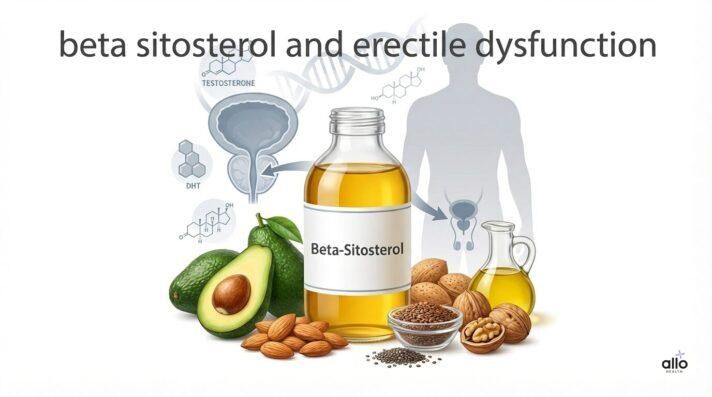
Beta-sitosterol is a plant-based sterol, also known as a phytosterol. It is similar to cholesterol in its chemical structure. It is naturally present in many everyday plant foods, especially nuts, seeds, vegetable oils, avocados, grains, and legumes. Because of this wide presence in plant foods, most people consume small amounts of beta-sitosterol daily without even realising it. [1] It is a white, waxy compound and is one of the most abundant phytosterols found in nature. Beyond foods, beta-sitosterol is commonly used as an active ingredient in a lot of supplements. Many prostate-health formulas and hair-loss products use beta-sitosterol because of its effects on inflammation, cholesterol metabolism, and some enzyme-blocking action. People take beta-sitosterol supplements for a lot of reasons:
Lowering cholesterol
Beta-sitosterol competes with dietary cholesterol in the intestines, reducing how much cholesterol your body absorbs — and for clinical ED, options like Viagra (Sildenafil) for ED remain first-line.
Improving BPH symptoms
It can help men with benign prostatic hyperplasia (BPH) by improving urinary flow and reducing urinary frequency.
Reducing inflammation
Research shows it has anti-inflammatory properties that may help with prostate health and certain skin conditions — while erection-specific options include Cialis for ED.

Hair-loss supplements
It is often added to hair-fall formulas because it may inhibit 5-alpha-reductase enzymes. This is the same enzyme targeted by finasteride, which helps in hair growth.
Can Beta-Sitosterol Help Erectile Dysfunction?
Many people search for natural supplements that might improve sexual performance, and beta-sitosterol is one of those that often comes up in discussions — along with prescription options like Levitra (Vardenafil) for ED. But when we look deeply at some research, it is clear that no human studies prove that it can improve erectile dysfunction. A lot of claims come from animal studies and studies that were done for prostate health, hormonal health, or other supplements. There are different animal studies done on beta-sitosterol. One study done on sexually inexperienced male rats found that beta-sitosterol isolated from the roots of Mondia whitei increased penile erections and prolonged ejaculation latency. This study shows sexual effects in rats, but it is not applicable to humans. suggest a prosexual effect in rats; they are not directly applicable to humans. These effects come from pharmacological doses of beta-sitosterol given in combination with other plant compounds rather than beta-sitosterol alone. [2] Human studies have shown different results. Clinical studies on beta-sitosterol in men with benign prostatic hyperplasia (BPH) show that sexual side effects may appear in a small percentage of users. A study done on men with benign prostatic hyperplasia showed that while urinary symptoms in BPH improved, impotence occurred in about 0.5% of men taking beta-sitosterol. [3] Another human study was done on a man who consumed the preparation of a plant, saw palmetto, which is rich in beta-sitosterol. It showed a sudden onset of erectile dysfunction and a drop in testosterone levels in men taking saw palmetto preparation. [4] These studies show that beta-sitosterol may not help with erectile dysfunction, but in a minority of cases, it may even contribute to it.
How Can Beta-Sitosterol Cause Sexual Problems?
Wondering how this naturally occurring compound can cause sexual problems? Let us understand some proven mechanisms behind this. Beta-sitosterol can affect some hormones in the body, and these changes may explain why some people can report erectile dysfunction or low libido. Your body uses an enzyme called 5-alpha-reductase to convert testosterone into a stronger by-product hormone called dihydrotestosterone (DHT). Beta-sitosterol can block this enzyme, just like the medicine finasteride does. [4] When this happens, the levels of DHT can go down, sexual desire may drop, and the erection quality may get weak. Not all people feel this change, but it can occur in some people because DHT plays an important role in sexual function. Beta-sitosterol may also interfere with another enzyme called aromatase, which helps in promoting balance between testosterone and estrogen in the body. When this balance shifts, it can cause hormonal disturbances and affect sexual desire and erection quality. [1]
The mechanism behind beta-sitosterol erectile dysfunction is linked to its inhibition of 5-alpha-reductase and its effect on androgen-estrogen balance. By reducing DHT levels and altering hormones, beta-sitosterol can influence libido, penile hemodynamics, and erectile function.
How safe is beta-sitosterol for erectile dysfunction?
Some men try taking beta-sitosterol, expecting benefits like more testosterone, better libido, or stronger erections, but none of these claims are supported by human studies. So, should you use beta-sitosterol for erectile dysfunction? The answer is no. It does not improve erections in humans and is not an ED treatment. While this compound may help with urinary flow in BPH, lower cholesterol, and reduce inflammation, it has no proven benefit for ED and may contribute to sexual side effects in some men. If you are experiencing erectile dysfunction, beta-sitosterol is not the solution. The right step is visiting a doctor, getting a medical evaluation, checking hormone levels, especially testosterone, and getting screened for common underlying conditions such as diabetes, high blood pressure, or cardiovascular issues.

Side effects of beta-sitosterol
Beta-sitosterol is considered safe for most people when taken in normal supplement doses, but it can affect sexual function in some men — and natural adjuncts like Ginkgo Biloba for ED are also worth discussing. It is not a treatment or supplement that can cure ED. Some cases report erectile dysfunction, reduced libido, or ejaculatory problems. These sexual side effects are uncommon but possible in people who are sensitive to hormonal changes. Other than sexual effects, beta-sitosterol may cause some digestive issues, such as nausea, gas, and constipation, and in some cases, it can influence hormone levels. It can also worsen a rare genetic condition called sitosterolemia, where the body absorbs too many plant sterols and becomes prone to early heart problems. [5]
Final Take
Beta-sitosterol may offer benefits for cholesterol control and urinary symptoms in BPH, but when it comes to erectile dysfunction, the answer is no. While generally safe for most people, beta-sitosterol is not an ED treatment, and relying on it for sexual problems may delay proper diagnosis and care. If you are experiencing erectile dysfunction, the best approach is to consult a doctor, check hormone levels, and evaluate underlying conditions such as diabetes, high blood pressure, obesity, or cardiovascular disease, because these factors have a far greater impact on sexual health.

Disclaimer
The following blog article provides general information and insights on various topics. However, it is important to note that the information presented is not intended as professional advice in any specific field or area. The content of this blog is for general educational and informational purposes only. The content should not be interpreted as endorsement, recommendation, or guarantee of any product, service, or information mentioned. Readers are solely responsible for the decisions and actions they take based on the information provided in this blog. It is essential to exercise individual judgment, critical thinking, and personal responsibility when applying or implementing any information or suggestions discussed in the blog.
Most Asked Questions
Is beta-sitosterol good for erectile dysfunction?
No. There is no human evidence showing that beta-sitosterol improves erections or treats ED. In fact, a small number of men may experience sexual side effects like reduced libido or weaker erections because beta-sitosterol can affect certain hormone-related enzymes.
What is the strongest treatment for erectile dysfunction?
The most effective treatments for ED are medically approved options such as prescription medications (like sildenafil, tadalafil, or vardenafil), lifestyle changes, hormone evaluation, and treating underlying medical conditions such as diabetes or high blood pressure. A doctor can help determine the best treatment for each individual.
What are the side effects of beta-sitosterol for men?
Most men tolerate beta-sitosterol well, but some may experience nausea, gas, constipation, reduced libido, erectile dysfunction, or hormonal changes. Rarely, it can worsen a genetic condition called sitosterolemia, where the body absorbs too many plant sterols.
Does beta-sitosterol decrease testosterone?
Human research has not shown that beta-sitosterol increases testosterone, and it is not a testosterone booster. Some animal studies suggest that high levels of phytosterols can reduce testosterone, and beta-sitosterol may influence enzymes like 5-alpha-reductase and aromatase, which can affect hormone balance.
Can beta-sitosterol cause erectile dysfunction?
Yes, in a small percentage of men, beta-sitosterol may contribute to sexual side effects like erectile dysfunction or low libido. This is likely due to its effect on hormone-related enzymes, especially 5-alpha-reductase, which plays a role in sexual function.
Sources
- 1.
Beta-Sitosterol
- 2.
Enhancement of erectile function of sexually naïve rats by β–sitosterol and α–β–amyrin acetate isolated from the hexane extract of Mondia whitei
- 3.
Beta‐sitosterols for benign prostatic hyperplasia
- 4.
Serenoa repens induced erectile dysfunction: Underdiagnosis and phytovigilance
- 5.
Beta-sitosterol-induced Acute Pancreatitis: A Case Report and Review of the Literature