What to Expect in Therapy: Your First Counselling Session and Beyond
Written by Dr. Srishti Rastogi

Dr. Srishti Rastogi is a medical writer and healthcare professional dedicated to high-quality patient education and public health awareness. Leveraging her clinical background, she produces deeply researched, evidence-based content for digital health platforms and medical publications. Dr. Srishti’s unique dual perspective as a clinician and communicator allows her to craft content that builds trust and credibility with readers navigating sensitive health topics.
•
July 23, 2026
Our experts continually monitor the health and wellness space, and we update our articles when new information becomes available.

Quick Read
A counselling session is a private conversation with a trained mental health professional who is there to listen and help, not to judge. Your first session is mostly about getting to know you and your concerns. You do not need to prepare a speech or have the right words ready. Over time, therapy gives you space to understand what you are going through and to build ways of coping that work for you.
Deciding to book a counselling session can feel like a big step, and it is normal to feel unsure about what actually happens once you walk in or log on. Many people put it off simply because they do not know what to expect.
The good news is that therapy is rarely what people imagine. You will not be analysed, labelled, or told what to do. A first session is a calm, guided conversation, and the pace is set by what feels comfortable for you.
This guide walks you through what a counselling session is, what happens in your first appointment and the ones after it, how long therapy usually takes, whether it stays private, and what therapy looks like in India.

Allo asks
Where are you in your therapy journey?
What Is a Counselling Session?
A counselling session, sometimes called therapy or talk therapy, is a scheduled meeting with a trained professional such as a counsellor, clinical psychologist, or psychiatrist. You talk, they listen closely, and together you work on whatever brought you there [1].

The aim is not for the therapist to hand you answers. It is to help you understand your thoughts, feelings, and patterns more clearly, and to find practical ways to manage them. Sessions usually last around 45 to 60 minutes and can happen in person or online [2].
People come to therapy for many reasons: stress, low mood, anxiety, relationship strain, grief, big life changes, or simply feeling stuck. You do not need a diagnosis or a crisis to deserve support. Wanting to feel better is reason enough.
What Happens in Your First Counselling Session?

The first session is often called an intake or assessment. Its main job is simple: to help the therapist understand you as a person and what you are hoping for [1].
Here is what usually happens.

Paperwork and Consent
Before or at the start, you may fill in a few forms. These cover your basic details, consent to begin therapy, and a privacy note explaining how your information is handled. This is also when your therapist explains confidentiality, which we cover below.
Talking Through What Brought You
Your therapist will invite you to share what is going on in your own words. They may gently ask about your background, such as your family, work, sleep, relationships, and any past support you have had. There are no right or wrong answers, and you can share only what you feel ready to share.
Setting Goals Together
Towards the end, you and your therapist begin to shape what you want from therapy. This might be feeling calmer, sleeping better, handling a relationship differently, or understanding yourself more. Goals can change as you go, and that is completely normal.
It is common to feel nervous or even a little emotional in a first session. That is a sign you are showing up honestly, not a sign anything is wrong.
Most people walk in thinking they need to have the 'right' things to say. You really don't. My job in that first session is just to listen and get a sense of you; the rest unfolds naturally from there.
What Happens After the First Session?
From the second session onwards, the work becomes more focused. Your therapist may use a particular approach depending on your needs. Some common ones include cognitive behavioural therapy, which looks at the links between thoughts, feelings, and actions, and other talking therapies that explore past experiences or relationships [2].
You do not need to know these names or choose between them in advance. A good therapist explains their approach in plain language and adapts it to you. Sessions often follow a gentle rhythm: checking in, working on a specific area, and sometimes trying small steps between sessions.
Progress is usually gradual rather than sudden. Some sessions feel like a breakthrough, others feel quieter, and both are part of the process.
How Long Does Therapy Take?
There is no fixed number of sessions that suits everyone. It depends on what you are working through, your goals, and the type of therapy [2].
Some focused approaches run for a shorter course of roughly 6 to 20 weekly or fortnightly sessions. Other people choose to continue for longer, especially when working on deeper or long-standing concerns. Your therapist will talk this through with you rather than lock you into a set plan.
If you ever feel unsure about how things are going, you can raise it directly. Therapy works best as an open conversation, including about therapy itself.
Is What I Say in Therapy Confidential?
Yes. What you share in a counselling session is kept private, and confidentiality is one of the foundations of therapy [4]. In India, your right to privacy and to give informed consent in mental health care is also protected under the Mental Healthcare Act, 2017 [6].
There are a small number of limits, which your therapist will explain at the start. A therapist may need to share information if there is a serious risk of harm to you or to someone else, or where the law requires it [4]. These limits exist to keep people safe, and they are rare.
If confidentiality is a worry for you, and for many people in India it is, you can ask your therapist to explain exactly how your information is stored and protected. A good professional will welcome the question.
What If Therapy Does Not Feel Right?
The relationship between you and your therapist matters a great deal, and research links a strong, trusting connection with getting more out of therapy [1]. Sometimes the first therapist you meet is not the right fit, and that is okay.
If you do not feel comfortable after a few sessions, you are allowed to say so or to look for someone else. Wanting a different therapist is not rude or a failure. It is part of finding care that works for you.
Does Therapy Actually Work?
For many people, yes. Decades of research show that most people who attend therapy are better off than those who do not get support for similar difficulties [3]. One large review found that about half of people notice meaningful improvement within around eight sessions, and about three in four benefit over the following months [3].
Therapy is not a magic fix, and it does not erase problems overnight. What it can do is help you feel more able to cope, understand yourself better, and manage what life brings. For some people it works well on its own, and for others it works alongside medication decided with a doctor.
What Does Therapy Look Like in India?
Access to mental health care in India is improving, but many people still hesitate to reach out. The National Mental Health Survey by NIMHANS estimated that a large share of people who could benefit from mental health support do not receive it, with stigma being one of the biggest reasons [5].
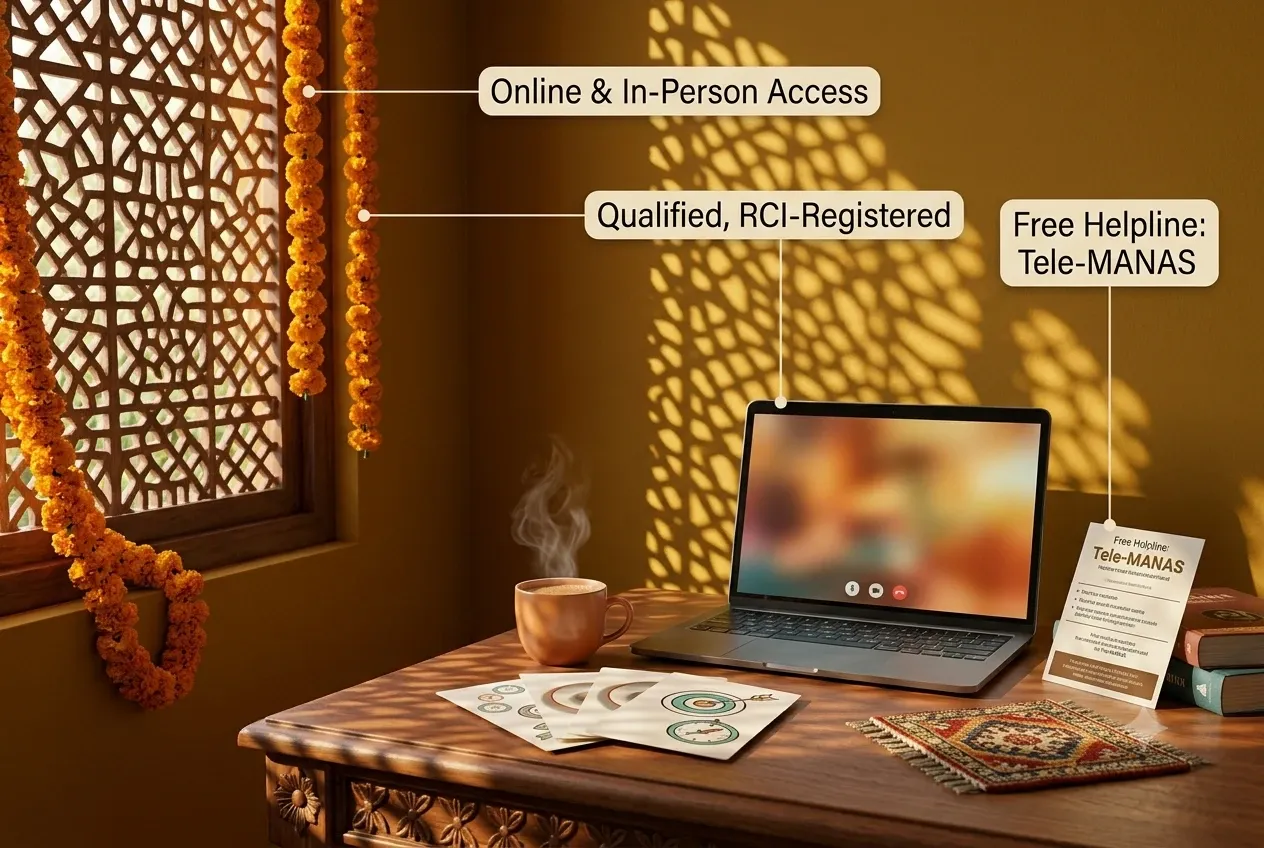
If you are considering therapy in India, a few things are worth knowing. Look for a qualified professional, such as a clinical psychologist registered with the Rehabilitation Council of India, or a psychiatrist. Both in-person and online sessions are widely available, which can make care easier to reach in smaller cities. Costs vary between providers, and lower-cost or free options exist through some NGOs, universities, and government services such as Tele-MANAS [7].
Feeling private or protective about seeking help is common and understandable. Reaching out is a sign of strength, not weakness.
Taking the First Step
If you have been thinking about therapy, that curiosity is worth listening to. A first counselling session asks very little of you: just your willingness to show up and talk. Everything else unfolds gently from there.
If this sounds like something you need, talking to a professional can help. You can book a confidential consultation with a qualified mental health professional at Allo Health, at a pace that feels right for you.
If you or someone you know is in crisis: Please reach out now. You can call Tele-MANAS: 14416 or 1-800-891-4416 (Govt. of India, 24x7, free, multiple languages) [7]. If there is immediate danger, go to the nearest hospital emergency department.

Disclaimer
The following blog article provides general information and insights on various topics. However, it is important to note that the information presented is not intended as professional advice in any specific field or area. The content of this blog is for general educational and informational purposes only. The content should not be interpreted as endorsement, recommendation, or guarantee of any product, service, or information mentioned. Readers are solely responsible for the decisions and actions they take based on the information provided in this blog. It is essential to exercise individual judgment, critical thinking, and personal responsibility when applying or implementing any information or suggestions discussed in the blog.
Most Asked Questions
Is it normal to feel nervous before therapy?
Very. Most people feel some nerves before a first session, and therapists expect it. The feeling usually eases once the conversation begins.
How should I prepare for my first therapy session?
You do not need to prepare much. It can help to jot down a few things on your mind, such as what prompted you to reach out or what you would like to feel different, but this is optional. Therapists are trained to draw out what matters through gentle questions, so arriving with an open mind is enough.
What should I do after my first session?
Give yourself a little space afterwards; it is common to feel tired, reflective, or even unexpectedly emotional once a session ends. Between sessions, some people find it helpful to jot down thoughts or situations that come up, which can be useful to bring to the next session, though this is entirely optional and not something your therapist will expect.
Is there a difference between counselling and psychotherapy?
The terms are often used interchangeably, and in everyday practice the line between them is blurry. Counselling tends to focus on specific, often shorter-term concerns, while psychotherapy can involve deeper, longer-term work on patterns of thinking and behaviour. Many professionals draw on both, and your therapist can explain which best describes the support they are offering you.
Do I need a doctor's referral to start therapy or see a psychiatrist in India?
For counselling or psychotherapy with a clinical psychologist or counsellor, you usually do not need a referral and can book directly. If you are specifically looking to see a psychiatrist, some clinics ask for a referral from a GP or your primary therapist, though many psychiatrists in India also accept direct bookings. It is worth checking with the specific provider.
Sources
- 1.
American Psychological Association. Understanding psychotherapy and how it works
- 2.
National Library of Medicine (NIH), StatPearls. Cognitive Behavior Therapy
- 3.
American Psychological Association. Recognition of Psychotherapy Effectiveness (policy resolution)
- 4.
American Psychological Association. Protecting your privacy: Understanding confidentiality in psychotherapy
- 5.
Gururaj G, et al. National Mental Health Survey of India, 2015-16: Summary. NIMHANS, Bengaluru (Government of India hosted copy)
- 6.
Government of India, Ministry of Law and Justice. The Mental Healthcare Act, 2017 (Gazette notification)
- 7.
Ministry of Health & Family Welfare, Government of India. Tele-MANAS
Why Should You Trust Us?
Why Should You Trust Us?
This article was written by Dr. Srishti Rastogi, who has more than 1 years of experience in the healthcare industry.
Allo has the expertise of over 50+ doctors who have treated more than 1.5 lakh patients both online and offline across 30+ clinics.
Our mission is to provide reliable, accurate, and practical health information to help you make informed decisions.
For This Article
- We cross-checked every claim in this article against primary sources from the American Psychological Association, the U.S. National Library of Medicine (NIH), and the Government of India, not third-party summaries, so the information reflects what these institutions actually publish.
- We referenced India's Mental Healthcare Act, 2017 directly from its official Gazette notification, rather than relying on paraphrased legal explainers, to accurately represent your confidentiality rights in therapy.
- We reviewed NIMHANS' National Mental Health Survey data to ground our claims about access and stigma in India in actual national research, not assumptions.
- We looked at how established clinical bodies describe psychotherapy's real-world effectiveness, including the APA's formal policy resolution on the topic, so our claims about outcomes are backed by research consensus rather than anecdote.
- We read through discussions on platforms like Reddit and Quora, including threads from Indian mental health communities, to understand the specific questions and hesitations first-time therapy-goers in India actually have, not just what a textbook assumes they'd ask.
- We verified that the crisis helpline numbers listed in this article (Tele-MANAS) are current and correctly sourced from the Ministry of Health & Family Welfare, so readers in distress reach the right support.