Insomnia and Sleep Disorders: Causes, Symptoms, and Treatment
Written by Dr. Srishti Rastogi

Dr. Srishti Rastogi is a medical writer and healthcare professional dedicated to high-quality patient education and public health awareness. Leveraging her clinical background, she produces deeply researched, evidence-based content for digital health platforms and medical publications. Dr. Srishti’s unique dual perspective as a clinician and communicator allows her to craft content that builds trust and credibility with readers navigating sensitive health topics.
•
July 23, 2026
Our experts continually monitor the health and wellness space, and we update our articles when new information becomes available.
Quick Read
Insomnia means ongoing difficulty falling asleep, staying asleep, or waking far too early, even when you have the time and space to sleep. It affects your days as much as your nights. Stress, mental health, physical illness, medicines, and an irregular routine can all feed into it. Long-term insomnia responds well to a structured talking therapy called CBT-I, which is the treatment doctors recommend first. Sleep medicines have a limited role and are used carefully. If poor sleep has been wearing you down for weeks, a professional can help you work out why.
Few things are as draining as wanting to sleep and not being able to. If your nights have become a cycle of watching the ceiling and your days a fog of tiredness, that is exhausting, and it is more common than you might think.
Insomnia is the medical name for that pattern, and it is treatable. Understanding what is behind it usually matters more than trying harder to sleep, because trying harder tends to make sleep more difficult, not less.
This guide explains what insomnia is, the symptoms to notice, what causes it, how it connects with mental health, the other sleep problems worth knowing about, how it is assessed, and the treatments that actually work.
What Is Insomnia?
Insomnia is ongoing difficulty falling asleep, staying asleep, or waking much earlier than you want to, even when you have the opportunity for enough sleep [1]. That last part matters. Sleeping five hours because your shift ends at midnight is a scheduling problem. Lying in bed for eight hours and sleeping four is insomnia.
It is one of the most common health complaints there is. Around one in three adults report insomnia symptoms at some point, and roughly one in ten live with long-term insomnia [1]. So if this is your experience, you are in very large company.


Allo asks
What best describes your sleep trouble?
Insomnia is also not simply a night-time problem. It shows up the next day as tiredness, low energy, and a mind that will not focus [2]. Doctors take that daytime effect seriously, because it is often what pushes people to finally seek help.
Short-Term and Long-Term Insomnia
Doctors usually think about insomnia in two broad patterns [3].
Short-term insomnia often follows something identifiable: a stressful few weeks, an illness, grief, a new baby, travel, or a change of shift. It tends to settle as the situation settles.

Long-term insomnia persists over months, often taking on a life of its own. The original trigger may have passed, but the worry about sleeping has become its own obstacle. This is the pattern that responds best to structured treatment rather than to willpower. Where your experience sits is not something to work out from an online list. A professional looks at the whole picture, and that assessment is what shapes the right treatment.
What Are the Symptoms of Insomnia?
Insomnia looks different from person to person. Most people notice some combination of the following [2]. At night, you may:
- Lie awake for a long time before falling asleep.
- Wake repeatedly during the night and struggle to drift off again.
- Wake very early in the morning and be unable to get back to sleep.
- Feel unrefreshed even after what looked like a full night.
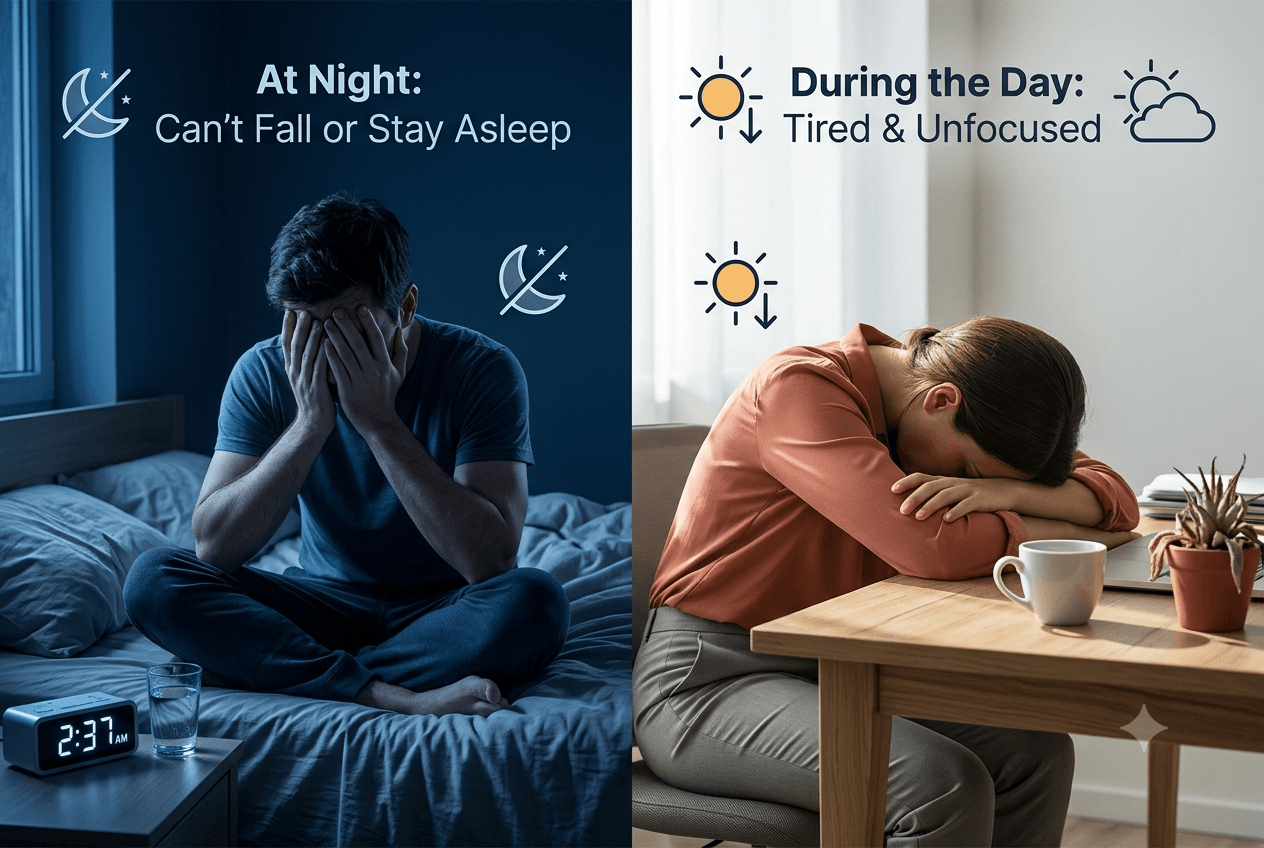
During the day, you may:
- Feel tired, heavy, or low on energy.
- Find it hard to concentrate, focus, or remember things.
- Feel irritable, anxious, or low in mood.
- Worry about sleep well before bedtime arrives.
That last one is worth pausing on. Dreading the night is one of the most common experiences people describe, and it is also one of the things treatment specifically works on. Symptoms overlap heavily with other conditions, from thyroid problems to depression to sleep apnea, which is exactly why a proper assessment matters rather than matching yourself to a list.
What Causes Insomnia?
Insomnia rarely has one single cause. It usually comes from several things overlapping, and the mix changes over time [2].
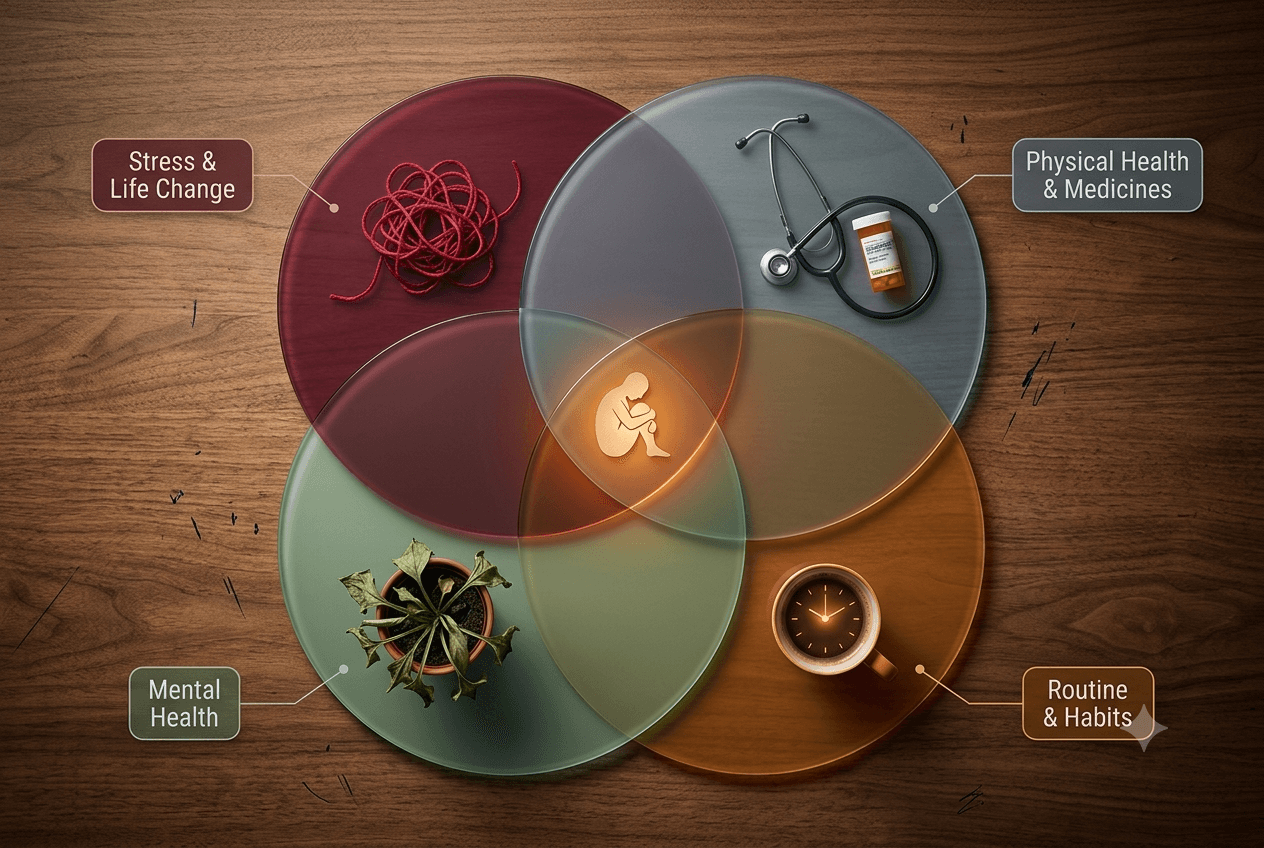
Common contributing factors include:
- Stress and life change: Work pressure, exams, money worries, caregiving, bereavement, and relationship difficulties are frequent triggers.
- Mental health conditions: Anxiety, depression, and trauma-related difficulties commonly disturb sleep.
- Physical health: Pain, breathing problems, acid reflux, an overactive thyroid, and needing to pass urine at night all interrupt sleep.
- Medicines: Some prescribed medicines affect sleep as a side effect. This is worth raising with your doctor rather than adjusting anything yourself.
- Caffeine, nicotine, and alcohol: All three affect sleep, and alcohol in particular fragments the second half of the night even though it makes you drowsy at first.
- Routine and environment: Shift work, long commutes, jet lag, irregular timings, and a hot, bright, or noisy room all make sleep harder.
Because the causes stack, working on everyday sleep habits is a sensible starting point for almost everyone. It is also, on its own, often not enough for long-term insomnia, which is covered further down.
The instinct is always to try harder, lie there and force it. But sleep doesn't work that way; the more you chase it, the further it moves. What actually helps is almost the opposite, working with your body's rhythm instead of fighting it.
How Insomnia and Mental Health Affect Each Other
Sleep and mental health travel together, and the influence runs in both directions [4]. Anxiety and low mood make it harder to sleep, and a long run of broken nights makes it harder to cope with anxiety and low mood.
This is common rather than unusual. Around half of people living with long-term insomnia also live with another mental health condition, most often anxiety or depression [1]. That does not mean poor sleep causes those conditions, or that having insomnia means you have one. It means the two often show up together, so treating them together works better than treating either alone.
It is also why ongoing sleep trouble is worth mentioning to a professional even if sleep is the only thing bothering you. Persistent stress and burnout that has been building for months, for example, may need attention alongside your sleep. Sleep problems sit within a wider picture of mental health and wellbeing, and looking at that whole picture usually gets better results.
What Are the Other Common Sleep Problems?
Insomnia is the most common sleep disorder, but not the only one [5]. A few others are worth recognising, because they are treated differently and are easy to mistake for insomnia.
Obstructive sleep apnea: Breathing repeatedly pauses during sleep, often with loud snoring and gasping. People usually feel very sleepy in the day despite spending long hours in bed. A partner often notices it before the person does.
Restless legs syndrome: An uncomfortable sensation in the legs with a strong urge to move them, typically worse in the evening and at rest, which delays sleep.
Circadian rhythm problems: The body clock and the required schedule fall out of step. Shift work and long-haul travel are common examples, and so is a natural body clock that runs much later than working hours allow.
Hypersomnia and narcolepsy: Here the difficulty is excessive daytime sleepiness rather than sleeplessness. Narcolepsy is an uncommon neurological condition affecting the control of sleep and wakefulness.
If any of these sound closer to your experience than insomnia does, mention it specifically when you see a doctor. Each is assessed and managed in its own way, and some need a sleep study to confirm.
How Is Insomnia Diagnosed?
There is no blood test for insomnia. Assessment is a conversation, and a fairly practical one [3].
A doctor will usually ask about your sleep pattern, how long it has been going on, your daily routine, work and shift timings, caffeine and alcohol, your physical health, any medicines you take, and how your mood and stress levels have been. Many will ask you to keep a simple sleep diary for a week or two, because what we remember about our sleep and what actually happens can differ.
A sleep study is not routine for insomnia. It is used when something else is suspected, such as sleep apnea or a movement disorder [2].
Only a qualified professional can work out what is behind ongoing sleep trouble. Online quizzes and symptom checklists cannot do this, and they often leave people more worried without being any closer to help.
How Is Insomnia Treated?
The reassuring part of this topic is that insomnia responds well to treatment, and the most effective treatment is not a medicine.
Cognitive Behavioural Therapy for Insomnia (CBT-I)
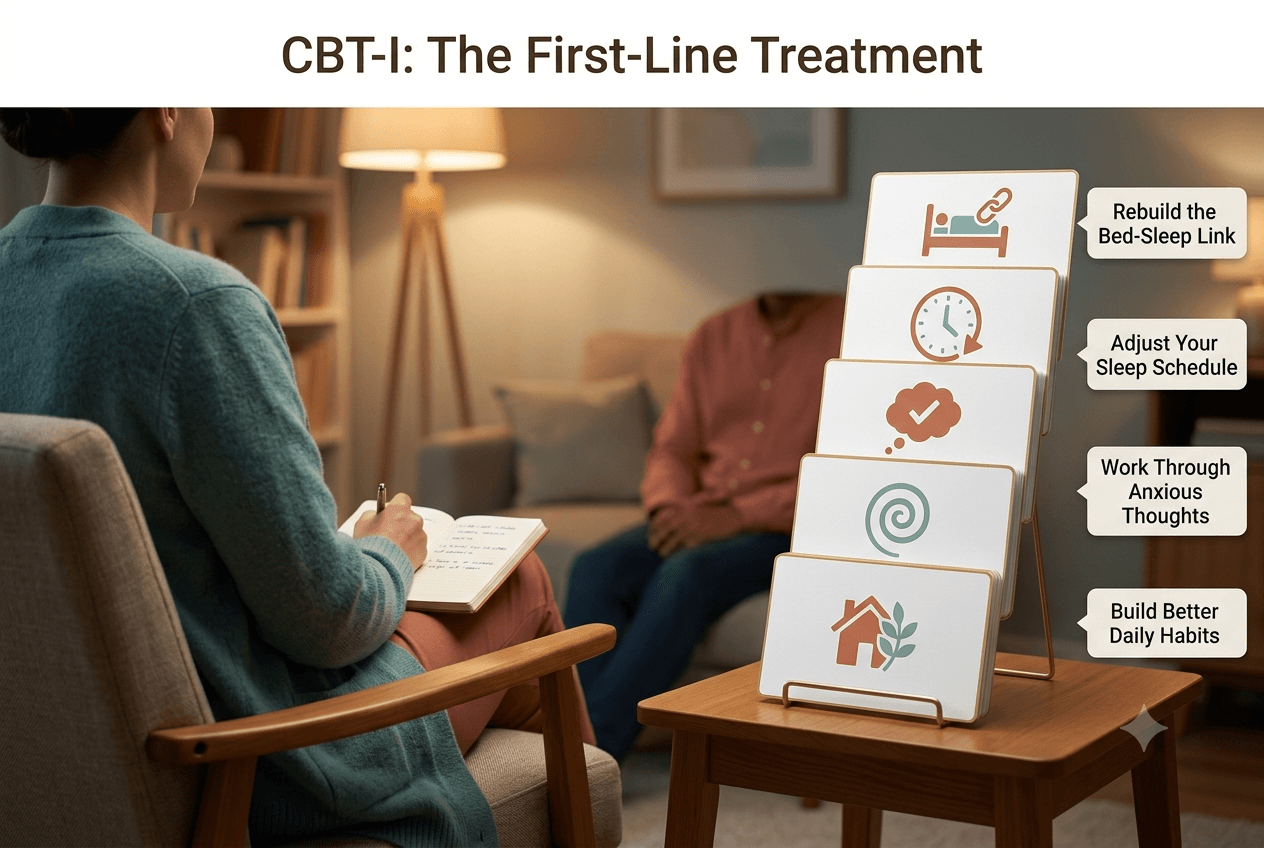
For long-term insomnia in adults, a structured talking therapy called cognitive behavioural therapy for insomnia, usually shortened to CBT-I, is what clinicians recommend first [6]. Both the American Academy of Sleep Medicine and the American College of Physicians recommend it as the initial treatment, ahead of medication [6][7].
CBT-I is practical rather than abstract. Working with a trained therapist over a short course of weekly sessions, it typically involves [6]:
- Rebuilding the link between your bed and sleep, rather than between your bed and lying awake.
- Adjusting your time in bed so that sleep becomes more solid, guided by the therapist.
- Working on the anxious thoughts about sleep that keep the mind alert at night.
- Relaxation techniques to make winding down easier.
- Reviewing the daily habits and surroundings that affect your sleep.
It helps many people, and the improvements tend to last, though how much it helps and how quickly varies from person to person. It also asks something of you in the first few weeks, when the schedule changes can feel demanding before they feel useful, so it works best with a therapist guiding it rather than attempted alone. CBT-I is increasingly offered online as well as in person, which makes it easier to reach if there is no trained provider near you [1]. If therapy is unfamiliar territory, it can help to read what happens in a session before you book.
Where Sleep Medicines Fit
Many people arrive at this topic wanting to know whether they need sleeping tablets, and often worried about becoming dependent on them.
Doctors are deliberately cautious here. Sleep medicines are generally not the first step for long-term insomnia, and where they are used it is usually for a short period and alongside other treatment [3][7]. In India, medicines that affect sleep are prescription-only, and starting or stopping any of them is a decision for your doctor, not something to try on your own. General information about psychiatric medicines and how they work is covered separately.
Treating What Sits Underneath
If anxiety, depression, pain, or another condition is feeding the insomnia, treating that alongside the sleep problem usually gives the best result [1]. This is one reason a proper assessment is worth the appointment rather than working through remedies one at a time.
Do Better Sleep Habits Fix Insomnia?
Partly, and this deserves an honest answer. Steady routines, a dark and cool room, less caffeine in the evening, and a calm wind-down genuinely help, and they are part of CBT-I itself. For short-term sleep trouble, they are often enough on their own.
For long-term insomnia, though, better habits alone usually do not resolve it [3][6]. That is not a sign you have done it wrong or not tried hard enough. It simply means the problem has moved beyond what habit change can reach, and it needs the structured approach described above. Habits remain worth keeping. They are the foundation, not the whole building.
When Should You See a Doctor?
It is worth speaking to a professional if [3]:
- Poor sleep has continued for several weeks despite reasonable changes to your routine.
- Tiredness is affecting your work, studies, mood, relationships, or safety, for example while driving.
- You are very sleepy in the day despite long hours in bed, or a partner has noticed you snoring loudly or stopping breathing.
- Sleep problems arrived alongside a change in your mood, anxiety levels, or physical health.
- You are relying on alcohol or any medicine to get to sleep.
Asking for help early tends to make things simpler, not harder. Sleep problems are a normal thing to bring to a doctor, and there is no need to wait until you are at the end of your rope.
Sleep Problems in the Indian Context
Reliable national data on insomnia in India is limited. Sleep medicine is a relatively young field here, and most studies are urban, questionnaire-based, and vary widely in what they measure.
What research there is suggests the problem is far from rare. A large national study of adults aged 45 and above found reported sleep disorders were more common among women, older adults, and people living in rural areas [8].
The everyday pressures will be familiar. Night shifts in IT, healthcare, manufacturing, and logistics, long commutes, late dinners, warm nights, and shared or joint-family sleeping spaces all make consistent sleep harder. Awareness that insomnia is treatable is still low, and trained CBT-I providers are concentrated in larger cities, though online delivery is steadily changing that.
Sleep Can Get Better
Insomnia is common, it is understandable, and it responds to treatment. Long-term sleep problems in particular have a well-established therapy behind them, and most people do not need to resign themselves to bad nights indefinitely.
If sleep has been difficult for weeks and you are tired of managing it alone, that is a good reason to talk to someone. You can book a confidential consultation with a qualified professional at Allo Health to understand what is happening and what would help.

Disclaimer
The following blog article provides general information and insights on various topics. However, it is important to note that the information presented is not intended as professional advice in any specific field or area. The content of this blog is for general educational and informational purposes only. The content should not be interpreted as endorsement, recommendation, or guarantee of any product, service, or information mentioned. Readers are solely responsible for the decisions and actions they take based on the information provided in this blog. It is essential to exercise individual judgment, critical thinking, and personal responsibility when applying or implementing any information or suggestions discussed in the blog.
Most Asked Questions
What is CBT-I?
CBT-I is cognitive behavioural therapy for insomnia, a short, practical course of sessions with a trained therapist. It works on the bed-sleep link, your sleep schedule, anxious thoughts about sleeping, relaxation, and daily habits.
Do I need sleeping pills for insomnia?
Not usually as a first step. Doctors are careful with sleep medicines and tend to prefer therapy first, using medicines briefly and alongside other treatment when appropriate. Any decision about them belongs with your doctor.
Is insomnia a mental illness?
No. Insomnia is a sleep disorder in its own right. It often occurs alongside anxiety or depression, and the two influence each other, but having insomnia does not mean you have a mental health condition.
Why do I wake up at the same time every night?
Regular night-time waking can relate to stress, alcohol, an underlying health problem, breathing problems during sleep, or a body clock out of step with your schedule. A doctor can help work out which applies to you.
How do I know if I have insomnia?
Only a professional can tell you that. If you regularly struggle to sleep despite having the time and space, and it is affecting your days, that is worth discussing with a doctor rather than diagnosing yourself from a checklist.
Sources
- 1.
Cleveland Clinic. Insomnia; Cognitive Behavioral Therapy for Insomnia.
- 2.
Mayo Clinic. Insomnia: Symptoms and causes.
- 3.
NHS. Insomnia.
- 4.
Alvaro PK, Roberts RM, Harris JK. A systematic review assessing bidirectionality between sleep disturbances, anxiety, and depression.
- 5.
National Heart, Lung, and Blood Institute (NIH). Sleep Science and Sleep Disorders.
- 6.
American Academy of Sleep Medicine. Behavioral and psychological treatments for chronic insomnia disorder in adults: an AASM clinical practice guideline.
- 7.
American College of Physicians. Management of Chronic Insomnia Disorder in Adults: A Clinical Practice Guideline. Annals of Internal Medicine.
- 8.
Prevalence of sleep disorders and association with various occupations among Indian population aged 45 years and above (LASI). PMC.
Why Should You Trust Us?
Why Should You Trust Us?
This article was written by Dr. Srishti Rastogi, who has more than 1 years of experience in the healthcare industry.
Allo has the expertise of over 50+ doctors who have treated more than 1.5 lakh patients both online and offline across 30+ clinics.
Our mission is to provide reliable, accurate, and practical health information to help you make informed decisions.
For This Article
- We referenced clinical practice guidelines directly from the American Academy of Sleep Medicine and the American College of Physicians, both of which recommend CBT-I as the first-line treatment for chronic insomnia, so the treatment guidance here reflects actual medical consensus, not popular opinion.
- We cross-checked symptom and cause information against Mayo Clinic and Cleveland Clinic, two of the most cited clinical references in sleep medicine, to keep the explanations accurate and current.
- We drew on a peer-reviewed systematic review examining the two-way relationship between sleep disturbances, anxiety, and depression, so our claims about insomnia and mental health are grounded in published research.
- We looked at Indian-specific data, including a national study of adults aged 45 and above (LASI) on sleep disorder prevalence, to reflect patterns in the Indian population rather than relying only on Western data.
- We distinguished clearly between short-term and long-term insomnia, and between what better sleep habits can and cannot fix, so the guide does not oversimplify a condition that genuinely needs professional assessment in many cases.
- We covered related sleep disorders, like sleep apnea and restless legs syndrome, that are commonly mistaken for insomnia, so readers can recognize if their experience points somewhere else entirely.