Dementia Medication: What It Can Do, the Main Types and What to Ask
Written by Dr. Srishti Rastogi

Dr. Srishti Rastogi is a medical writer and healthcare professional dedicated to high-quality patient education and public health awareness. Leveraging her clinical background, she produces deeply researched, evidence-based content for digital health platforms and medical publications. Dr. Srishti’s unique dual perspective as a clinician and communicator allows her to craft content that builds trust and credibility with readers navigating sensitive health topics.
•
September 24, 2026
Our experts continually monitor the health and wellness space, and we update our articles when new information becomes available.

Quick Read
No medicine cures dementia or stops it. Some medicines can ease memory and thinking problems for a while in some people, mainly in Alzheimer's disease. Which medicine fits depends on the type of dementia. Medicines for agitation carry real risks in older people and are a last step, not a first one. Other everyday medicines can make confusion worse, so a full medicine review matters. Never stop or change a dementia medicine without the doctor.
If your parent, spouse or another family member has been prescribed a dementia medicine, you may be wondering what to expect. Will their memory improve? How long does the medicine take to work? What happens if you cannot see a difference?
These are important questions because dementia medicines do not work like a painkiller, where you may notice a clear effect within hours. Their benefits can be small and gradual. In some people, the aim may simply be to help them manage certain everyday tasks for a little longer.
Here is what these medicines can and cannot do.

Allo asks
What kind of help are you looking for for your loved one?
What Do Dementia Medicines Do?
Dementia medicines cannot cure dementia or completely stop it from progressing. Some medicines can, however, help with symptoms such as memory, thinking and the ability to manage everyday activities [5]. The medicines most commonly used include donepezil, rivastigmine, galantamine and memantine.
Donepezil, rivastigmine and galantamine belong to a group called cholinesterase inhibitors. They work by increasing the availability of a brain chemical involved in memory and thinking. They are mainly used for mild to moderate Alzheimer’s disease [1]. Memantine works in a different way. It affects another brain chemical involved in learning and memory. It may be used for moderate Alzheimer’s disease when cholinesterase inhibitors are not suitable, and for severe Alzheimer’s disease. In some people, memantine is added to an existing cholinesterase inhibitor [1].

Indian guidelines say there is no clear evidence that one cholinesterase inhibitor is better than the others [4]. The doctor may therefore consider the person’s symptoms, other health conditions, side effects and how easy the medicine is to take. If medicine names and groups are difficult to follow, Understanding Psychiatric Medications explains how medicines are prescribed, monitored and reviewed.
Do Dementia Medicines Actually Work?
They can help, but the improvement is usually modest and varies from person to person. A Cochrane review of 30 studies looked at donepezil in Alzheimer’s disease. Over about six months, people taking donepezil did slightly better in memory, thinking and everyday activities than those taking a placebo [2].
Memantine has also shown a small benefit in people with moderate to severe Alzheimer’s disease. The same benefit has not been shown in mild Alzheimer’s disease [3]. This is important when setting expectations.
Someone taking dementia medication may not suddenly start remembering forgotten names or become as independent as they were several years ago. Instead, you may notice smaller changes. They may remain able to dress themselves, follow a familiar routine or take part in conversations for longer.

Sometimes there is no obvious improvement at all.
That does not always mean the medicine is doing nothing. Dementia continues to progress, so it can be difficult to know how the person would have been without treatment [4]. This is why doctors usually look at several things together, including memory, daily activities, behaviour and what the family has noticed at home.
Keeping short notes can help. For example, note whether the person is still preparing tea independently, finding their way around the house or remembering familiar routines. These observations can be useful during follow-up visits.
Which Dementia Medicine Is Used for Each Type?
Dementia is not one disease. Alzheimer’s disease, Lewy body dementia, vascular dementia and frontotemporal dementia affect the brain differently.
That means a medicine that is useful for one type of dementia may not be useful for another.
| Type of dementia | Medicines that may be used |
|---|---|
| Alzheimer’s disease | Donepezil, rivastigmine, galantamine or memantine, depending on the stage |
| Lewy body dementia | Donepezil or rivastigmine; memantine may be considered if these are unsuitable |
| Vascular dementia | These medicines are generally considered only when Alzheimer’s disease or Lewy body dementia is also suspected |
| Frontotemporal dementia | Cholinesterase inhibitors and memantine are not recommended |
These recommendations are based on NICE guidance [1]. For example, a person with frontotemporal dementia would not usually be given donepezil simply because they have memory or behaviour changes. The diagnosis matters.
If your family is still trying to understand what the diagnosis means, read our guide to dementia. It explains the different types, early signs and how dementia is assessed.

What Happens When Someone Starts Dementia Medication?
Treatment is usually started carefully. The doctor may begin with a lower dose and increase it gradually if the person is tolerating it well. This gives the body time to adjust and can reduce some side effects.
Indian psychiatry guidelines suggest doing an ECG, or heart tracing, before starting a cholinesterase inhibitor [4]. This matters because these medicines can slow the heartbeat in some people. The person should also be reviewed after starting treatment. Indian guidelines suggest a review after about four to six weeks to check for side effects and decide whether the dose needs to be changed [4].
The first few weeks are therefore not only about asking, “Is the memory better?” They are also about checking whether the medicine is safe and tolerable.
Side effects of donepezil, rivastigmine and galantamine
Common side effects can include nausea, vomiting, diarrhoea, poor appetite and weight loss [4]. These medicines can also slow the heartbeat. In some people, that may contribute to dizziness, fainting or falls.
Stomach-related side effects are common, especially when treatment first begins. They may improve if the medicine is started at a lower dose or increased more slowly [4]. Nausea and poor appetite often settle after the first couple of weeks [5].
If the person is eating much less, losing weight, fainting or falling, tell the doctor. Do not simply wait for the next routine appointment if the problem is significant.
When a dementia medicine is started, we look at more than memory. Appetite, weight, dizziness, falls, behaviour and the person’s ability to manage everyday activities can all help us judge how treatment is going.
Side effects of memantine
Memantine can cause headache, dizziness or constipation [5].
These effects are often temporary. But dizziness is worth watching carefully in an older person because it may increase the risk of falls.
If side effects are difficult to manage, it does not always mean dementia treatment has to stop completely. The doctor may adjust the dose, change the medicine or consider another form. Rivastigmine, for example, is also available as a skin patch.
Are Antipsychotics Used in Dementia?
Sometimes. Antipsychotics may be considered if a person with dementia has severe agitation, aggression or hallucinations that are causing serious distress or a risk of harm [1].
These medicines are used cautiously because they can increase the risk of stroke and death in older people with dementia [6,7]. If prescribed, the lowest effective dose should be used for the shortest possible time, with regular reviews [1].
Before prescribing an antipsychotic medicine, the doctor will usually look for other reasons behind a sudden behaviour change, such as pain, infection, constipation or another illness. Extra caution is needed in Lewy body dementia, as some people can have severe reactions to these medicines [1].

Can Other Medicines Make Dementia Symptoms Worse?
Yes. Some medicines can increase confusion, sleepiness or memory problems, particularly in older adults [1].
This is why it helps to bring a complete medicine list to appointments. Include prescription medicines, over-the-counter medicines, sleeping tablets, supplements and herbal products. Ask the doctor whether any of them could be making the symptoms worse.
Do not stop a regular medicine on your own. If sleep is a concern, it may also help to look at the person’s routine before turning to sleeping medicines. Read more about Insomnia and Sleep Disorders and Sleep Hygiene.
What Are the Newer Alzheimer’s Medicines?
Newer medicines such as lecanemab and donanemab target amyloid, a protein that builds up in the brain in Alzheimer’s disease. They are intended for certain people with early Alzheimer’s disease, not everyone with dementia [10]. Tests are needed to confirm amyloid before treatment [8].
These medicines can slow the decline caused by early Alzheimer’s disease, but they do not cure it. They can also cause a side effect called ARIA, which involves swelling or small areas of bleeding in the brain and can occasionally be serious [9].
If your family member has early Alzheimer’s disease, a neurologist can tell you whether these treatments may be suitable and currently available.
How Can Families Manage Dementia Medicines Safely at Home?
For many families, the difficult part is not just choosing a medicine. It is managing it every day. A person with dementia may forget whether they have already taken a tablet. They may take it twice, refuse it or struggle to swallow it. If several medicines are involved, the routine can become confusing for everyone.
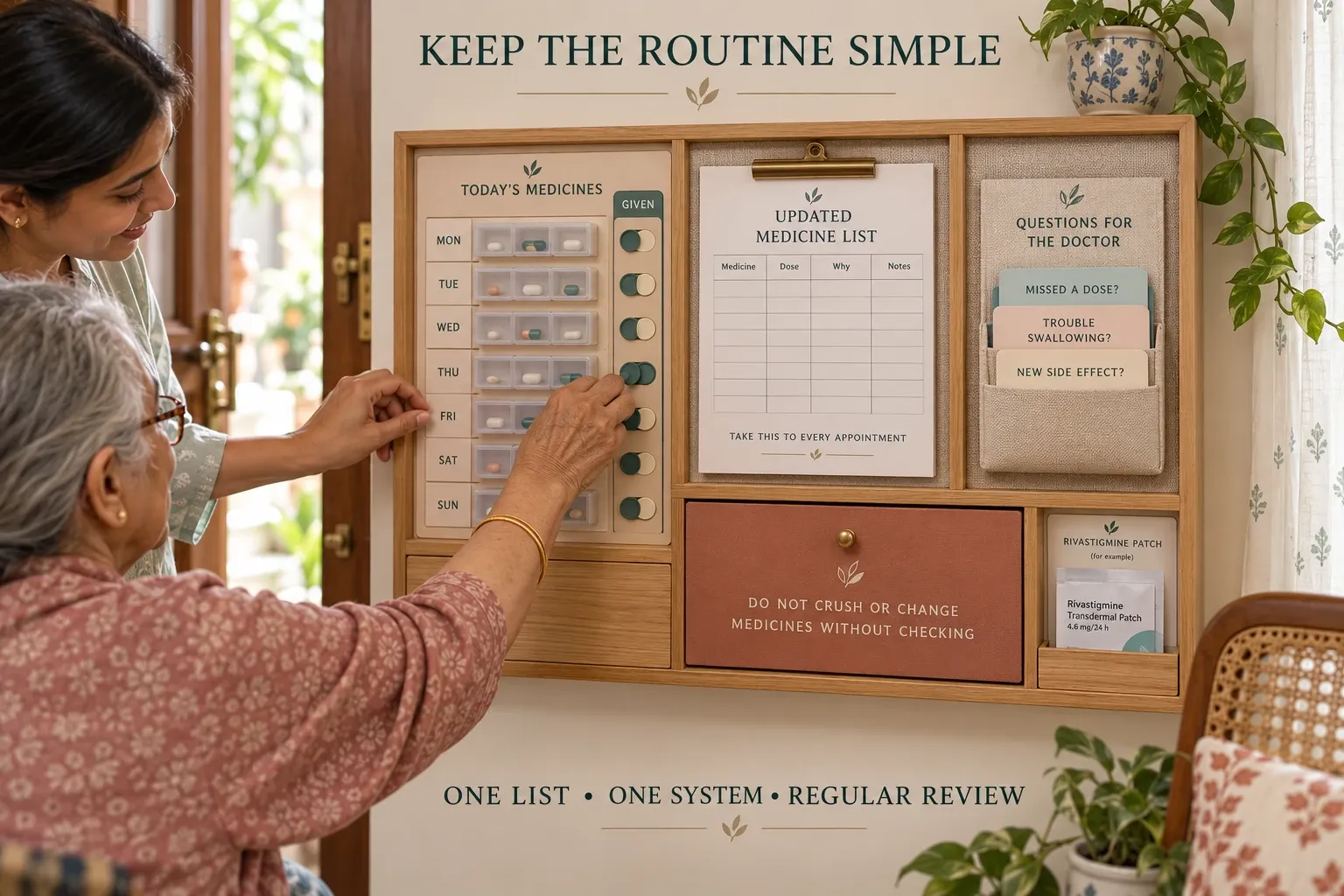
Try to keep the system simple. Keep one updated medicine list and take it to every medical appointment. If appropriate, a weekly pill organiser can make doses easier to track. It can also help to have one family member oversee the medicine routine rather than several people assuming someone else has given the dose.
If swallowing becomes difficult, tell the doctor. Do not automatically crush tablets because some medicines should not be crushed. Another formulation may be available. Rivastigmine, for example, can be given through a skin patch [4].
Medicine is also only one part of dementia care. Families often find themselves managing appointments, behaviour changes, sleep, safety and daily routines at the same time. Our guide to Supporting a Loved One has practical advice on helping someone without trying to manage everything alone.
Can Dementia Medication Be Stopped?
There may come a point when the family wonders whether continuing the medicine is worthwhile. Do not stop it just because you cannot see an obvious improvement. Instead, the doctor should look at the whole situation.
Is the medicine still likely to be helping? Is it causing troublesome side effects? Has the person’s ability to manage everyday activities changed? What has the family noticed?
These questions matter more than looking at memory alone. If the doctor decides that a medicine should be stopped, ask how to do it safely. Do not change the dose or stop treatment without medical advice.

What Should You Ask the Doctor?
Medical appointments can feel rushed, and it is easy to forget questions once you are sitting in the consultation room. Write them down beforehand.
Useful questions include:
- What type of dementia does my family member have?
- Why have you chosen this particular medicine?
- What improvement can we realistically expect?
- How long should we try it before judging whether it is helping?
- Which side effects should we watch for?
- When should we contact you before the next appointment?
- Could another medicine be making the confusion worse?
- What should we do if a dose is missed?
- What should we do if swallowing tablets becomes difficult?
The goal is not simply to give a medicine and continue it indefinitely. Treatment should be reviewed as the person’s needs change.
If changes in memory, mood, sleep or behaviour are becoming difficult to understand, you can also speak with a mental health professional at Allo Health. They can help you make sense of the symptoms and understand what questions may be useful to discuss with the treating doctor.

Disclaimer
This blog article discusses mental health and emotional wellbeing for general educational and informational purposes only. It is not a substitute for professional advice, diagnosis, or treatment, and only a qualified mental health professional, such as a psychiatrist, psychologist, or licensed therapist, can diagnose a condition or recommend treatment. If you are struggling, please reach out to a qualified professional or someone you trust; if you are in crisis or may be at risk of harming yourself, use the crisis support resources on this page. For any decisions about your mental health, we encourage you to seek the guidance of a qualified professional.
Most Asked Questions
How long before we know if the medicine is working?
The first review, after four to six weeks, is mainly to check side effects [4]. Any benefit is judged over months, on thinking, daily tasks and the doctor's overall view [4]. Keep short notes on what you see at home and take them to each review.
Do memory tonics, ginkgo or herbal remedies help?
India's psychiatry guidelines say ginkgo and piracetam do not have clear evidence for routine use in dementia [4]. There isn't enough evidence to say whether other remedies, such as curcumin or coconut oil, work, and some can interact with prescribed medicines [5]. Tell the doctor before adding any product sold for memory, and never use one in place of prescribed treatment.
Will blood pressure tablets, cholesterol tablets or aspirin slow Alzheimer's?
They are not given for that purpose. UK guidance says they should not be offered specifically to slow Alzheimer's disease, outside research trials [1]. If they have been prescribed for the heart, blood pressure or diabetes, keep taking them as prescribed.
Can a sleeping pill or melatonin help with poor sleep?
UK guidance says melatonin should not be offered for sleep problems in Alzheimer's disease [1]. It suggests a plan built around the person, with daylight, exercise, activity during the day and good sleep habits [1]. Ask the doctor before giving any sleep medicine, including one bought over the counter.
Should low mood in dementia be treated with an antidepressant?
Not routinely, if both the dementia and the depression are mild to moderate [1]. Talking treatments are considered first in that situation [1]. It is different if the person already had a severe mental health condition that needed medicine, so tell the doctor about their history.
Sources
- 1.
NICE Dementia Guideline NG97
- 2.
Donepezil for Dementia Due to Alzheimer’s Disease, Cochrane
- 3.
Memantine for Dementia, Cochrane
- 4.
Clinical Practice Guidelines for Management of Dementia, Indian Journal of Psychiatry
- 5.
NHS, Dementia Treatment
- 6.
Risk of Death With Atypical Antipsychotic Drug Treatment for Dementia, JAMA
- 7.
MHRA, Antipsychotics and Dementia
- 8.
Lecanemab in Early Alzheimer’s Disease, NEJM
- 9.
FDA, Lecanemab Approval
- 10.
FDA, Donanemab Approval
Why Should You Trust Us?
Why Should You Trust Us?
This article was written by Dr. Srishti Rastogi, who has more than 1 years of experience in the healthcare industry.
Allo has the expertise of over 50+ doctors who have treated more than 1.5 lakh patients both online and offline across 30+ clinics.
Our mission is to provide reliable, accurate, and practical health information to help you make informed decisions.
For This Article
- This article was created for people who are trying to understand dementia medication for a parent, spouse or another family member. It focuses on the questions that often matter at home: what improvement to realistically expect, which side effects to watch for, how medicines are reviewed and what to do when taking them becomes difficult.
- The treatment information has been checked against established clinical guidelines, systematic reviews and medical research. Sources include NICE dementia guidance, Cochrane reviews, Indian clinical practice guidelines, NHS guidance and published evidence on newer Alzheimer's treatments.
- We have been careful not to describe dementia medicines as a cure or promise that memory will improve. Their benefits can be modest and may look different from person to person. This is why the article also explains how changes in everyday activities, behaviour and independence can help families and doctors judge whether treatment may be helping.
- Safety information is included alongside treatment information. This covers side effects such as poor appetite, weight loss, dizziness and a slow heartbeat, as well as the risks of antipsychotic medicines in older people with dementia. We also explain why families should not stop, crush or hide medicines without first speaking to the treating doctor.
- Our aim is to help families understand the treatment plan, notice useful changes at home and arrive at medical appointments with better questions. This information is educational and does not replace an individual assessment by the person's doctor or dementia specialist.