ADHD Medication for Adults: Types, Side Effects and Safety
Written by Dr. Srishti Rastogi

Dr. Srishti Rastogi is a medical writer and healthcare professional dedicated to high-quality patient education and public health awareness. Leveraging her clinical background, she produces deeply researched, evidence-based content for digital health platforms and medical publications. Dr. Srishti’s unique dual perspective as a clinician and communicator allows her to craft content that builds trust and credibility with readers navigating sensitive health topics.
•
September 25, 2026
Our experts continually monitor the health and wellness space, and we update our articles when new information becomes available.

Quick Read
ADHD medicine is the most studied treatment for adult ADHD, and for many people it clearly reduces symptoms. It works best alongside practical changes and therapy, not instead of them. There are two main groups, stimulants and non-stimulants. Your doctor checks your heart health before you start and your pulse and blood pressure while you take it. In India, the stimulant used for ADHD is controlled under the narcotics law. It should never be shared or stopped on your own.
If you or someone you know is in crisis, help is available right now. You are not alone, and things can get better with the right support.
If you have recently been diagnosed with ADHD, starting medicine may feel like a big decision. You may wonder whether it will help you work, study or manage everyday tasks, and whether you will still feel like yourself.
This guide explains what ADHD medication can do, what happens at a medicine review and which questions to ask your doctor.
What Does ADHD Medication Do for Adults?
ADHD medication can make it easier to pay attention, pause before acting and manage restlessness. You might find it easier to follow a conversation, finish a task or return to what you were doing after an interruption.
The change is different for each person. Medicine does not automatically organise your day or teach you how to plan. Reminders, a place for important items and support at work or home may still help. Some adults also find therapy useful for managing the effects ADHD has had on their confidence or relationships. Read more about ADHD in adults and what to expect in therapy.
Research supports medication for reducing core ADHD symptoms in adults, although its long-term effects and impact on overall quality of life are less certain [2].


Allo asks
What is your biggest question about ADHD medication?
What Are the Main Types of ADHD Medication?
| Type | Examples | What to expect |
|---|---|---|
| Stimulants | Methylphenidate; other stimulants used in some countries | May improve symptoms on the day you take them. Short-acting and long-acting forms are available. |
| Non-stimulants | Atomoxetine; other options depending on local availability | Taken regularly. Atomoxetine usually takes several weeks to show its full benefit. |
Stimulants are often offered first to adults when they are suitable [1]. If a stimulant does not help enough or causes difficult side effects, a doctor may consider another medicine.
In India, the options may differ from those listed on foreign websites. Indian guidance identifies methylphenidate as the stimulant used for ADHD and atomoxetine as a non-stimulant option [3]. Ask your doctor which medicines are currently available and suitable for you.
Do All Adults With ADHD Need Medicine?

No. The decision depends on how much your symptoms affect your life and what support you want.
Tell your doctor where you are having difficulty. For example, you may be missing deadlines at work, struggling to manage bills, forgetting appointments or finding it hard to complete daily tasks. This gives you and your doctor a clearer way to judge whether treatment is helping.

You can discuss medicine alongside practical changes, such as written reminders, a quieter workspace or breaking large tasks into smaller steps. If you also have anxiety or depression, mention it. Your doctor can consider both conditions when planning treatment [1].
ADHD medicine should help you manage everyday tasks while still feeling like yourself. Tell your doctor what has changed at work or home, and mention any problems with sleep, appetite or mood. Those details help us decide whether the medicine and dose are right for you.
What Does a Doctor Check Before Prescribing?
Before starting ADHD medication, your doctor should ask about your symptoms, other health conditions and any medicines or substances you use. They should also record your weight, pulse and blood pressure [1].
Tell them if you have a heart condition, faint during exercise, get unusual breathlessness or have a close relative who died suddenly from a heart problem at a young age. These details may change which checks you need. Most adults do not need an ECG routinely, but some need further assessment based on their history [1].
Be open about alcohol or drug use too. This helps your doctor choose and monitor treatment safely.
How Soon Will You Know Whether It Works?
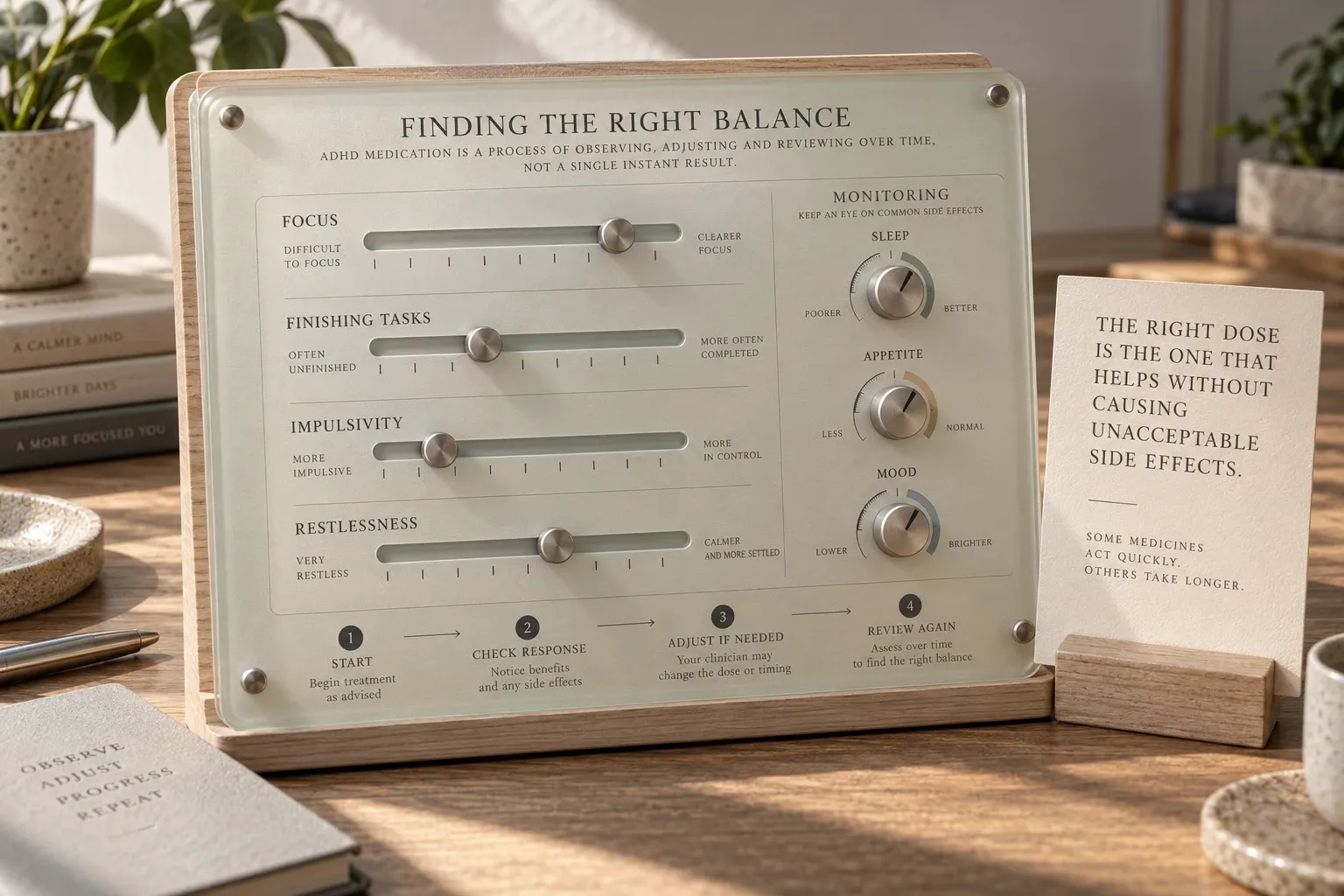
A stimulant may affect attention on the day you take it. Finding the right dose can still take several appointments. Atomoxetine works more gradually and may take several weeks.
Your doctor may ask you to track a few specific changes:
- Can you start and finish an important task?
- Are you less distracted during work or conversations?
- Are impulsive decisions causing fewer problems?
- Are side effects affecting your sleep, appetite or mood?
A dose adjustment or change of medicine is common. It does not mean treatment has failed. NICE recommends an adequate trial before deciding that a medicine has not helped enough [1].
What Side Effects Should You Watch For?
Side effects depend on the medicine. With stimulants, common ones include reduced appetite, trouble sleeping, headache, stomach discomfort and irritability [6].
Tell your doctor if you:
- Are losing weight without intending to
- Cannot sleep well
- Feel unusually anxious, low or unlike yourself
- Have a racing heartbeat or feel faint
- Notice a side effect that makes work or daily life harder
Your doctor may change the dose, timing or medicine. If sleep has become a problem, read more about insomnia.
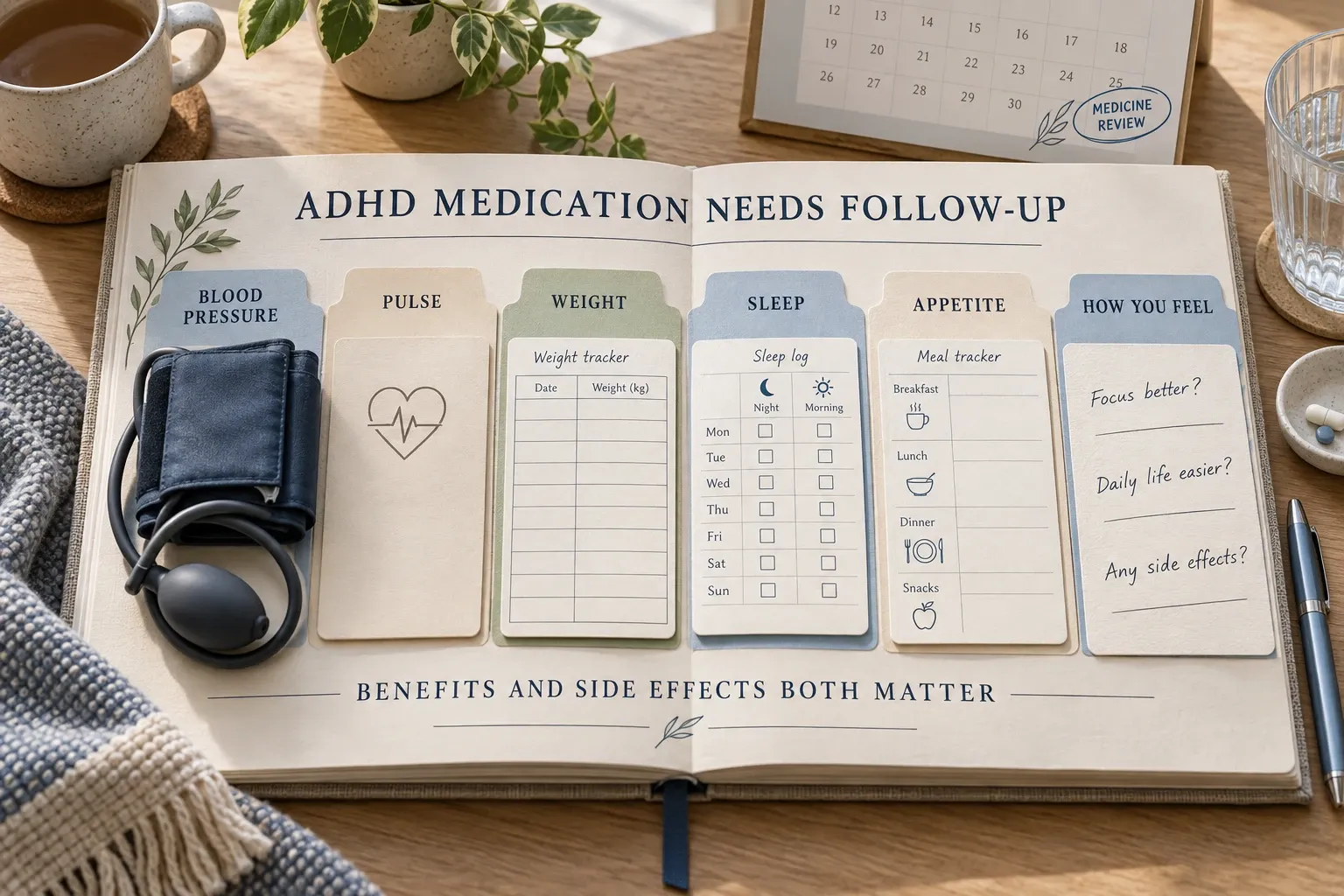
ADHD medicines can affect pulse and blood pressure. NICE recommends checking both after dose changes and at least every six months during treatment. Weight should also be monitored [1].

Can ADHD Medication Cause Addiction?
Prescription stimulants can be misused and carry a risk of addiction, particularly when taken differently from how they were prescribed [9]. Taking extra tablets to stay awake or sharing them with someone else is unsafe.
If your own use is worrying you, tell your doctor without waiting for the next routine review. You can discuss this without being judged.
Keep stimulant medication somewhere secure, especially if you live with other people. Never give your tablets to a friend or family member, even if they think they have ADHD [9].
What Are the Prescription Rules in India?
ADHD medicines require a prescription. Methylphenidate is also regulated under India’s narcotics law and stricter drug rules [3][4][5].
Keep your prescription and medicine packaging, and arrange a follow-up before you run out. If you are travelling, carry the medicine in its original packaging with your prescription. Check the destination’s rules before international travel, as controlled-medicine rules vary.
Do not buy ADHD tablets from an unverified website or use someone else’s prescription.
How Long Do Adults Take ADHD Medication?
There is no fixed end date. Some adults use medication for a longer period because it continues to help them. NICE recommends a review at least once a year to discuss the benefits, side effects and whether treatment is still needed [1].
If you want to pause or stop, tell your prescriber. The stopping plan depends on the medicine. Some medicines need gradual reduction, and
a planned review can help you see whether symptoms return [1][6]. Ask what to do if you miss a dose rather than making up for it yourself.
What Should You Ask at Your Appointment?
Take your medicine strip or prescription and ask:
- What change should I expect from this medicine?
- How soon will we review whether it is helping?
- Which side effects should I contact you about?
- When will you check my weight, pulse and blood pressure?
- What should I do if I miss a dose or want to stop?
If you are unsure whether medicine is right for you, a confidential consultation with a mental health professional at Allo Health can help you discuss the options.

Disclaimer
This blog article discusses mental health and emotional wellbeing for general educational and informational purposes only. It is not a substitute for professional advice, diagnosis, or treatment, and only a qualified mental health professional, such as a psychiatrist, psychologist, or licensed therapist, can diagnose a condition or recommend treatment. If you are struggling, please reach out to a qualified professional or someone you trust; if you are in crisis or may be at risk of harming yourself, use the crisis support resources on this page. For any decisions about your mental health, we encourage you to seek the guidance of a qualified professional.
Most Asked Questions
How quickly does ADHD medicine work?
Doctors judge whether a medicine is working over a trial of about six weeks at the right dose, not after a day or two [1]. Ask your doctor what change to expect, and when.
Is there an over-the-counter ADHD medicine?
No. Every medicine used to treat ADHD in India needs a prescription.
Will ADHD medicine change my personality?
If you feel flat, unlike yourself or unusually low on it, tell your doctor. The dose or the medicine can be changed.
Is it safe to take ADHD medicine for years?
Some adults take it for years, with a review at least once a year [1]. The short-term evidence is strong, but long-term use has been studied less [2], which is one reason the review matters.
Can I take ADHD medicine while pregnant or breastfeeding?
It depends on the medicine. It is a decision to make with your doctor, ideally before you plan a pregnancy. Don't stop a prescribed medicine suddenly on your own.
Sources
- 1.
National Institute for Health and Care Excellence. Attention Deficit Hyperactivity Disorder: Diagnosis and Management (NG87).
- 2.
Ostinelli EG, Schulze M, Zangani C, et al. Comparative Efficacy and Acceptability of Pharmacological, Psychological, and Neurostimulatory Interventions for ADHD in Adults. The Lancet Psychiatry. 2025;12(1):32–43.
- 3.
Shah R, Grover S, Avasthi A. Clinical Practice Guidelines for the Assessment and Management of Attention-Deficit/Hyperactivity Disorder. Indian Journal of Psychiatry. 2019;61(Suppl 2):176–193.
- 4.
Government of India. Notification S.O. 1055(E): Methylphenidate Under the NDPS Act.
- 5.
Central Drugs Standard Control Organisation. The Drugs Rules, 1945.
- 6.
Healthdirect Australia. ADHD Medicines.
- 7.
US Food and Drug Administration. FDA Updating Warnings to Improve Safe Use of Prescription Stimulants.
Why Should You Trust Us?
Why Should You Trust Us?
This article was written by Dr. Srishti Rastogi, who has more than 1 years of experience in the healthcare industry.
Allo has the expertise of over 50+ doctors who have treated more than 1.5 lakh patients both online and offline across 30+ clinics.
Our mission is to provide reliable, accurate, and practical health information to help you make informed decisions.
For This Article
- This article uses ADHD treatment guidance from NICE and the Indian Psychiatric Society. The original sources are linked in the references.
- It explains what a person can expect before starting medicine, during dose adjustments and at later reviews. It also covers the weight, pulse and blood pressure checks used to monitor treatment.
- The article addresses practical questions for readers in India, including prescription requirements, keeping a prescription for refills and why a medicine mentioned on a foreign website may not be available locally.
- It explains both the possible benefits and the risks of stimulant medicines, including misuse and sharing. It does not recommend a brand or dose.
- Treatment advice is kept general because the right medicine depends on a person’s symptoms, health history and other medicines. The named psychiatrist and review date should be added after medical review is complete.